
Weather office radars go offline, providing services by borrowing
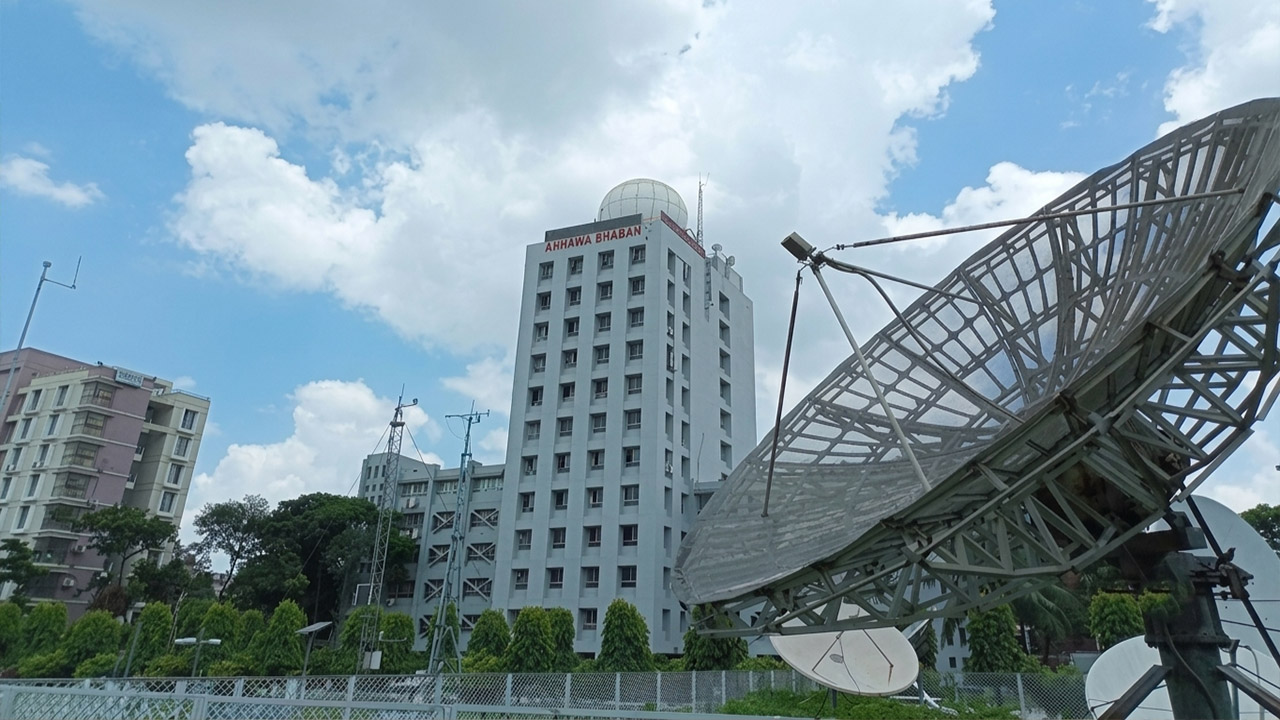
Cyclones, storm surges, or severe thunderstorms—when it comes to receiving early warnings of natural disasters, people across Bangladesh, especially in coastal areas, rely primarily on the Bangladesh Meteorological Department (BMD). The agency depends on five modern Doppler weather radars to provide accurate and real-time weather information nationwide. However, all five of these radars are now out of service.
As a result, the Meteorological Department is currently preparing weather forecasts using data borrowed from other agencies. Experts warn that with the country's radar network inoperative during the peak monsoon and cyclone season, Bangladesh's ability to issue timely and accurate weather forecasts has been seriously compromised.
The BMD operates Doppler radar stations in Dhaka, Cox's Bazar, Khepupara (Patuakhali), Rangpur, and Moulvibazar. Of these, the radars in Cox's Bazar, Khepupara, and Moulvibazar have remained completely non-functional for a long time due to technical faults, expired equipment, and inadequate maintenance.
Visitors to the Meteorological Department's website see the message "Under Maintenance" when they click on links for these radar stations.
Although the remaining two radars were supposed to be operational, they are now also offline. The Rangpur radar has been out of service since June 17 this year because of technical problems, while the Dhaka radar has been offline since Saturday (July 4).
What the Experts Say
According to experts, malfunctioning weather radars mean that authorities cannot obtain precise, real-time information on the direction and movement of storms approaching from the sea. This significantly increases the risk to the lives and property of millions of people living in coastal areas.
Climate researcher Professor Dr. Ahmad Kamruzzaman Majumder, Founder and Chairman of the Center for Atmospheric Pollution Studies (CAPS), told Asia Post:
"With three radars completely out of service, coastal residents are being deprived of accurate and comprehensive weather information. During the previous Awami League government's tenure, there was serious negligence in maintaining and monitoring these radars. Corruption was also involved."
He added:
"Repairing these damaged radars and ensuring accurate weather forecasts for coastal communities is now a major challenge for the current government. I urge the authorities to give this issue immediate attention and take effective measures to restore the radar network as quickly as possible."
Mustafa Kamal Palash, a meteorology and climate researcher at the University of Saskatchewan in Canada, explained:
"A weather radar has an effective range of approximately 400 kilometers. Once a storm enters that range from the sea, the radar can detect it. Such a storm usually takes at least 12 to 24 hours to make landfall. That means a functioning radar can provide nearly a full day's advance warning about a storm's speed and direction."
Referring to a low-pressure system that has formed over the northwestern Bay of Bengal, he said:
"Strong winds and rainfall have already begun affecting Bangladesh's coastal regions. Since all coastal radars are currently out of service, it is impossible to accurately monitor the movement of this low-pressure system. As a result, coastal communities are now more vulnerable. If a major cyclone develops, they will face severe risks."
Limitations of Satellite Monitoring
Palash also pointed out the limitations of satellite observations:
"Satellite images only show cloud formations. They cannot accurately determine how much rainfall those clouds will produce. Moreover, weather satellites orbit about 36,000 kilometers above the Earth's surface, meaning their data is not always completely precise. In this regard, weather radar remains the most effective tool. Therefore, restoring the coastal radars—as well as the Dhaka radar—should be an urgent priority to protect lives and property."
Meteorological Department's Response
Responding to the situation, meteorologist Tariful Kabir Nawaz of the Bangladesh Meteorological Department told Asia Post:
"Our three radars in Cox's Bazar, Khepupara, and Moulvibazar are out of service due to technical problems. The Rangpur radar is also offline because of an Automatic Voltage Regulator (AVR) malfunction. Since it is still under warranty, specialists from the Japanese manufacturer will repair it."
Asked when the Rangpur radar would be operational again, he replied:
"The Japanese experts are either already on their way to Dhaka or have already arrived. They will restore the system as soon as possible."
Regarding the Dhaka radar, he said, "We were receiving data from the Dhaka radar until Saturday (July 4). However, it suddenly stopped functioning due to a power supply problem. Our engineers have already been informed and are working to restore it quickly."
On alternative arrangements, he added, "For the time being, we are preparing our regular weather reports and forecasts using data obtained from Bangladesh Air Force radar systems."
Powerful Monsoon Rain Band Approaching
While the country's weather radar network remains largely inoperative, Bangladesh is now facing the season's second major and fully developed monsoon rain band, named "Dhara."
According to the Bangladesh Weather Observation Team (BWOT), a private weather research organization, the rain band is expected to affect the country in phases from July 5 to July 13, bringing rainfall to approximately 90–100 percent of Bangladesh.
In a statement posted today on its official Facebook page, BWOT said the rain band would first become active over southern Bangladesh before gradually spreading across the entire country. The most intense phase is expected between July 7 and July 11.
Regional Rainfall Forecast
Throughout the "Dhara" rain band event, skies are expected to remain mostly cloudy across Bangladesh.
The system is forecast to be most active in the Sylhet, Chattogram, Barishal, and Mymensingh divisions, where prolonged and persistent rainfall is likely, with very little sunshine.
The Dhaka and Khulna divisions are also expected to experience significant rainfall.
Meanwhile, the Rangpur and Rajshahi divisions may see moderate to comparatively lower rainfall, with some parts of Rajshahi likely receiving less rain than the rest of the country.
Risk of Landslides and Flash Floods
Although the rain band is not expected to trigger widespread flooding nationwide, meteorologists have warned of several localized natural hazards.
Very heavy rainfall could significantly increase the risk of landslides in the Chattogram Hill Tracts.
In addition, heavy rainfall in the Indian states of Assam and Meghalaya may send upstream floodwaters into Bangladesh, raising the possibility of temporary flash floods in border areas of the Sylhet and Mymensingh divisions.
Continuous rainfall may also lead to temporary waterlogging in low-lying areas of Sylhet, Mymensingh, the hill district of Bandarban, and Bangladesh's coastal regions.