
100,000 Pharmacies operating without registration, 237 more added every month
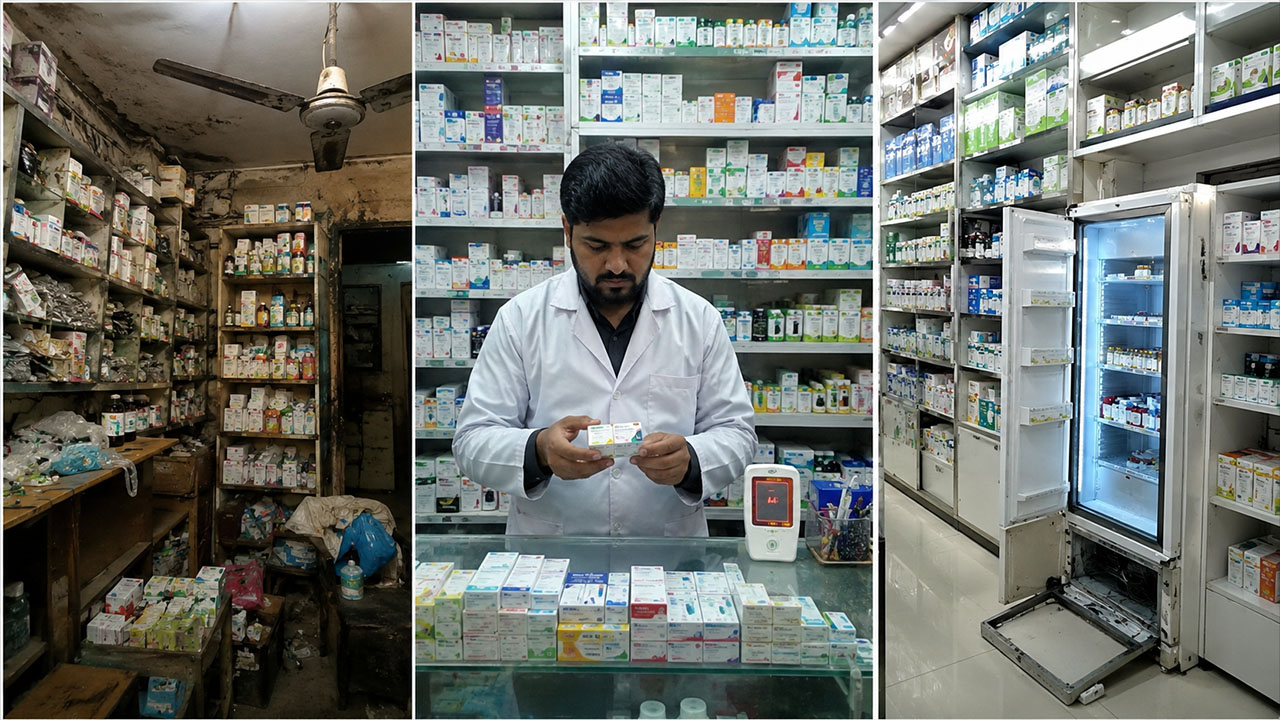
Nearly 100,000 drug stores across Bangladesh are operating without registration, while the number of licensed pharmacies has exceeded 225,000. This figure is far above the standard recommended by the World Health Organization (WHO).
Despite this, an average of 237 new pharmacies are being licensed every month. Moreover, 93 percent of existing pharmacies lack proper temperature control systems or model pharmacy infrastructure, putting the quality and effectiveness of medicines at risk.
According to WHO guidelines, there should be between five and 10 pharmacies for every 10,000 people. Based on Bangladesh's population of around 180 million, a maximum of 190,000 pharmacies would be sufficient.
However, the country already has more than 226,000 registered pharmacies, in addition to nearly 100,000 unlicensed retail drug outlets. Of these, only about 7 percent comply with even basic regulatory standards.
Professor Dr. Syed Sabbir Haider of the Department of Pharmaceutical Technology at the University of Dhaka told Asia Post, "Bangladesh has far more pharmacies than it actually needs.
Drug stores are as common as grocery shops. Even in developed countries, and in neighboring India, pharmacies are not located this close together. The government has failed to regulate licensing based on population density."
Rush to Issue Licenses
According to the Directorate General of Drug Administration (DGDA), despite the country already having more than twice the required number of pharmacies, an average of 237 new outlets receive licenses every month.
DGDA regulations require a model pharmacy to have at least 300 square feet of permanent space, while a model medicine shop must have at least 120 square feet. Both must be equipped with air conditioning and a functioning refrigerator for storing insulin, vaccines, and other temperature-sensitive medicines.
Between January 2025 and May 2026, the DGDA issued licenses to 4,029 pharmacies. Of these, only 79 were approved as model pharmacies, accounting for just 1.96 percent of the total.
The DGDA also acknowledged that around 100,000 pharmacies remain unregistered and said steps are being taken to bring them under the licensing system.
Heat Is Damaging Drug Effectiveness
Model pharmacies are considered essential for ensuring quality healthcare, protecting public health, and maintaining medicine quality. However, DGDA data show that only 7 percent of registered pharmacies have been certified as model pharmacies or model medicine shops. This means the remaining 93 percent still operate outside the modern regulatory framework, which requires air conditioning and proper temperature-controlled storage.
WHO guidelines require medicines to maintain their quality and effectiveness throughout the entire supply chain, from warehouses to retail outlets. Strict environmental controls—including temperature, humidity, and light exposure—are considered essential.
According to WHO standards, medicines should generally be stored at temperatures between 15°C and 25°C (up to 30°C depending on climate), with relative humidity below 60 percent. Certain life-saving medicines and vaccines must be stored under cold-chain conditions with continuous temperature monitoring.
Any fluctuation in storage temperature can reduce the effectiveness of sensitive medicines, potentially harming patients. Compliance with internationally accepted storage standards is therefore critical.
Visits to pharmacies in Shahbagh, Aziz Cooperative Medicine Market, and markets opposite Shaheed Suhrawardy Medical College Hospital found that the vast majority lacked air conditioning.
At Shahbagh, around 40 pharmacies operate in the ground-floor market. Only a handful had air-conditioning systems. Popular Medical Store, which sells medicines both wholesale and retail, also lacked any cooling system.
Owner Jogesh Chandra Karmakar told Asia Post, "We know medicines can lose their quality. But the department has never instructed us about this."
At Aziz Market, Sanim Pharma owner Mohammad Forkan Uddin said market authorities collected money promising to install central air conditioning but never implemented it.
A similar situation was observed at Mosque Market opposite Shaheed Suhrawardy Medical College Hospital, where all 18 pharmacies operate without proper cooling facilities.
Saiful Islam, marketing manager of Moon Moon Pharma, said, "Since the market faces west, direct sunlight hits the shops. Without temperature control, medicine quality may deteriorate. Either the pharmacists' association or the owners' association should take action. If they fail, the DGDA should enforce stricter measures."
Cancer Medicines Sold Without Prescriptions
The Drugs and Cosmetics Act, 2023 prohibits the sale of prescription medicines without a valid prescription from a registered physician. The restriction is even stricter for highly sensitive medicines such as cancer drugs.
However, field observations suggest the law is widely ignored.
At Samara Drugs, located beside the National Institute of Cancer Research and Hospital, a patient named Faruk Ahmed was seen purchasing breast cancer medication without a prescription.
"I had the medicine name written on my mobile phone. They gave it to me immediately without asking for any prescription," he said.
DGDA Director Akhtar Hossain admitted the problem.
"Most people in Bangladesh still buy medicines without consulting doctors. It has become a long-standing habit. Although the law allows a fine of Tk20,000, it cannot be fully enforced because of social realities," he said.
Reluctance to Renew Licenses
Under existing regulations, drug licenses must be renewed every two years. However, many pharmacy owners fail to comply.
Mitford, the country's largest wholesale medicine market, illustrates the problem.
At Chayanika Medicine Corner on D.C. Roy Road, the pharmacy's registration expired on July 1 last year. Staff member Sajib Barman claimed a renewal application had been submitted but was unable to provide any supporting documents.
Across Dhaka, unregistered pharmacies have mushroomed in residential neighborhoods. Shiuli Pharmacy on East Ulan Road in Rampura has reportedly been operating without registration for three years. Of 10 pharmacies visited in the area, only three possessed valid licenses.
DGDA Director and spokesperson Dr. Md. Akhtar Hossain told Asia Post, "There may be around 100,000 pharmacies operating without registration. We are conducting enforcement drives, but launching large-scale crackdowns could create social unrest. Therefore, we are giving businesses time to comply."
Another DGDA director, speaking anonymously, alleged that many illegal pharmacies survive under the protection of large wholesale distributors.
"Many businesses obtain retail licenses but actually operate wholesale businesses. These unregistered outlets are major channels for counterfeit and substandard medicines entering the market," he said.
Owners Avoid Hiring Graduate Pharmacists
DGDA Director Akhtar Hossain acknowledged both regulatory failures and manpower shortages.
"Graduate pharmacists are essential for ensuring medicine quality. However, most pharmacy owners do not want to hire them because of the higher salaries. In addition, staff shortages make it difficult to conduct regular field inspections," he said.
Regarding the fact that only 7 percent of pharmacies qualify as model pharmacies, he added:
"It is still too early to be satisfied with progress. Many outlets ignore our conditions. They choose very small rented spaces to reduce costs, although model pharmacies require at least 300 square feet. Air conditioning and graduate pharmacists are mandatory, but these conditions are frequently ignored."
He said the country's major pharmaceutical companies should take the lead in expanding the model pharmacy system.
"If capable pharmacy owners prioritize model pharmacies to preserve medicine quality, others will follow. This will help ensure that people receive safe, high-quality medicines," he said.
Professor Dr. Syed Sabbir Haider of the University of Dhaka said many pharmacy owners prefer hiring secondary school students rather than graduate pharmacists.
"They believe that if students from classes eight to ten can run the business, why should they pay higher salaries to graduate pharmacists? There is a clear lack of commitment from both the Directorate General of Drug Administration and pharmacy owners," he said.