
Rooppur Nuclear Power Plant opens new prospects for Bangladesh's energy sector
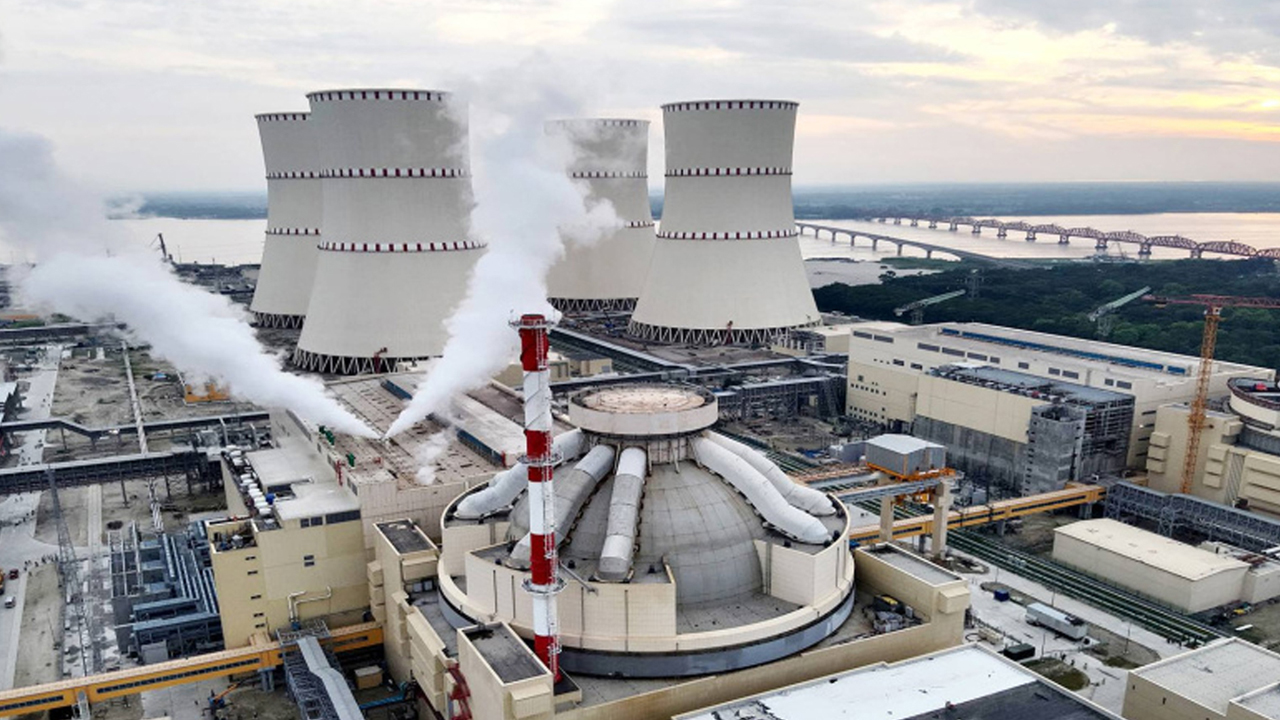
The country's first nuclear power plant, built on the banks of the Padma River, has opened a new chapter for Bangladesh's energy sector.
Once fully completed in 2028, the two reactors of the Russian-assisted Rooppur Nuclear Power Plant are expected to supply up to 15 percent of the country's total electricity demand. For a developing economy like Bangladesh, the project is being viewed as a bold investment in nuclear energy to meet growing energy needs without excessive long-term expenditure.
According to a Bloomberg report published on Sunday (July 12), Bangladesh's nuclear venture is being closely watched by other developing nations around the world. At present, crowds of local visitors gather in front of the project's four massive cooling towers to take selfies, reflecting growing public interest in the landmark facility.
For developing countries like Bangladesh, nuclear energy offers a significant opportunity to reduce dependence on fossil fuels while strengthening economic resilience. It is also expected to help cushion the impact of geopolitical shocks such as the Iran war.
During the Iran conflict, disruptions to oil and gas exports from the Persian Gulf led to recurring fuel shortages at filling stations across Bangladesh. Rural households endured daily power outages lasting several hours, while factories struggled with energy shortages that hampered production.
R. Srikanth, head of the Energy, Environment and Climate Change Programme at the National Institute of Advanced Studies in Bengaluru, India, said the recent conflicts involving Iran and the Russia-Ukraine war have demonstrated that shortages of critical resources affect poorer nations far more severely than wealthier ones. According to him, this strengthens the case for nuclear energy in developing economies.
The 2.4-gigawatt Rooppur Nuclear Power Plant has taken more than a decade to build. During that period, the project faced multiple setbacks, including the COVID-19 pandemic, Russia's war in Ukraine, and the Iran conflict. These events reinforced Bangladesh's strategy of reducing its heavy reliance on imported fossil fuels. However, they also delayed the project's original target of commissioning the first unit by 2023.
Md. Zahedul Hasan, Managing Director of Nuclear Power Plant Company Bangladesh Limited, said the first reactor is now expected to become fully operational in early 2027, while the second reactor is scheduled to begin operation a year later.
Shafiqul Alam, lead analyst at the Institute for Energy Economics and Financial Analysis (IEEFA), said Bangladesh is unlikely to require new power generation targets for the national grid over the next five to seven years. He noted that the Rooppur plant would help meet future electricity demand while creating opportunities to accelerate renewable energy deployment and invest in grid modernization.
Professor Md. Shafiqul Islam of the Department of Nuclear Engineering at the University of Dhaka said the sight of visitors taking selfies in front of the plant reflects growing public confidence in the country's capabilities. He added that the project has become a source of national pride, with many Bangladeshis believing that if neighboring India and Pakistan can successfully operate nuclear power plants, Bangladesh can do so as well.
Like many other developing economies, however, Bangladesh has also experienced rising costs associated with nuclear power projects. According to the World Nuclear Association, the plant's original contract with Russia's Rosatom, including fuel for the initial years of operation, was valued at approximately $12.65 billion. Since the project was approved more than a decade ago, the Bangladeshi taka has depreciated significantly against the US dollar, increasing the project's cost in local currency by roughly one-quarter.
The report notes that Rosatom's financing model has helped ease this burden by offering long-term loans, allowing Bangladesh to repay the initial investment over 20 to 25 years.
In an email to Bloomberg, Rosatom stated that nuclear power provides developing economies with a foundation for long-term national development, stronger energy security, industrial growth, and the development of advanced engineering and scientific expertise.
As part of its long-term energy strategy, Bangladesh is also examining the potential use of Small Modular Reactors (SMRs). Power and Energy Minister Iqbal Hasan Mahmud said preliminary discussions are underway with suppliers including Rolls-Royce Holdings Plc and Chinese manufacturers.
The minister said the government is focusing on reactors with capacities ranging from 300 to 400 megawatts, as these smaller facilities can be built more quickly along rivers and require less space than conventional large-scale reactors.
"We will no longer pursue large-scale projects because they involve greater liabilities," he said.
In recent years, nuclear power has experienced a global resurgence. Following the 2011 Fukushima disaster in Japan, concerns over safety risks and cost overruns caused many countries to scale back their nuclear ambitions. However, the growing need for carbon-free electricity, driven by artificial intelligence (AI) and the electrification of transportation, has renewed global interest in nuclear energy.
Nuclear power offers several key advantages: it is low-carbon, reliable, and capable of providing continuous electricity. It is also considered an ideal complement to intermittent renewable energy sources such as solar and wind, helping stabilize modern electricity grids.
Nevertheless, until emerging technologies such as SMRs become fully mature, even the most committed countries will continue to face challenges including high upfront capital costs, lengthy construction periods, and the risk of costly delays.
Toby Dalton, senior fellow and co-director of the Nuclear Policy Program at the Carnegie Endowment for International Peace, said the perception of nuclear power as a symbol of modernization has contributed to growing enthusiasm among developing nations. However, he cautioned that governments must first ensure they possess all the essential elements required to operate a nuclear power program sustainably. These include a skilled workforce, an independent and reliable regulatory authority, broad public support, and effective systems for managing spent nuclear fuel.
Dalton warned that excessive enthusiasm surrounding nuclear energy could lead countries to make poor decisions.
"I don't think any developing economy wants to become a laboratory for technologies that have not yet been proven or demonstrated elsewhere," he said.
Another challenge is the limited number of technology suppliers, creating long-term strategic relationships. The global nuclear market is dominated by a small group of countries—including the United States, Russia, China, France, and South Korea—that offer only a limited range of reactor technologies.
According to the World Nuclear Association, most of the 80 nuclear reactors currently under construction worldwide are located in Asia, with China and Russia leading the market. Both countries are actively promoting not only their existing technologies but also newer reactor designs that are still several years away from full commercial maturity, aiming to expand their geopolitical influence.
Developments in neighboring countries have also increased Bangladesh's interest in nuclear energy. India plans to expand its nuclear power capacity elevenfold to 100 gigawatts by 2047. As part of that strategy, Rosatom is constructing four 1-gigawatt reactors at Kudankulam in southern India.
Meanwhile, according to the World Nuclear Association, China has supplied Pakistan with six nuclear reactors with a combined electricity generation capacity of approximately 3.3 gigawatts.