
Feni farmers shift from paddy to grass cultivation
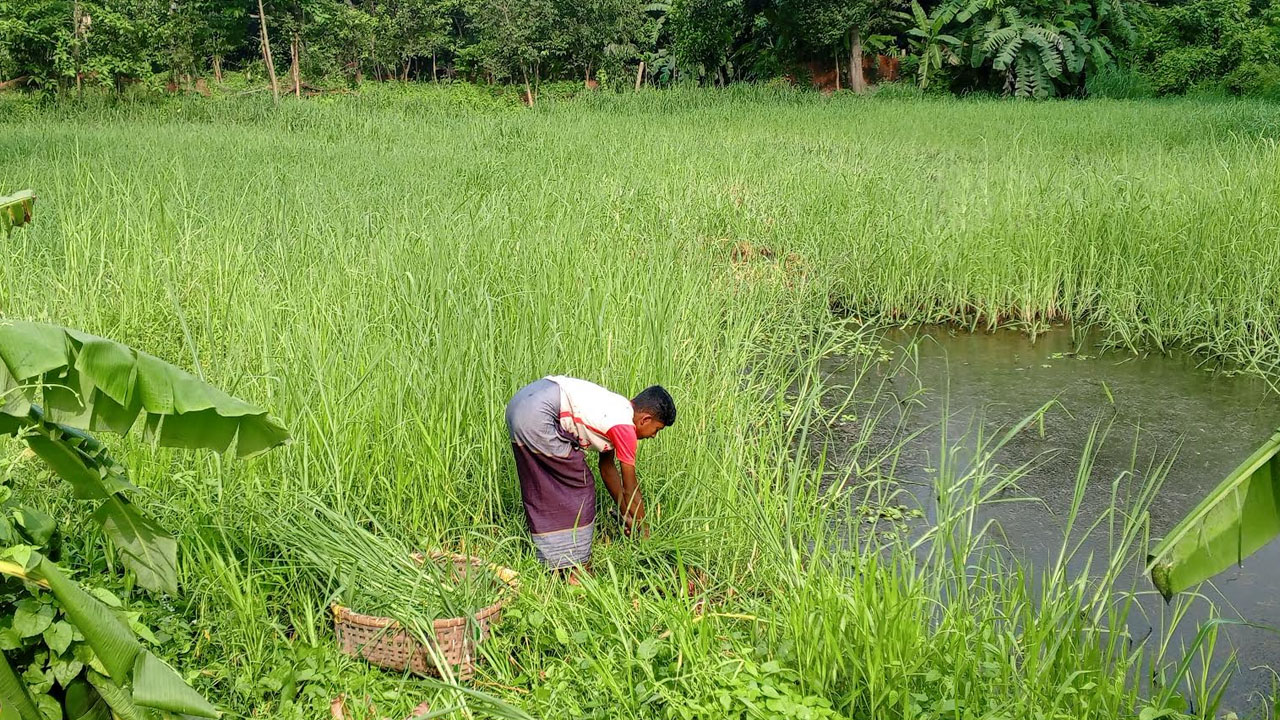
Paddy cultivation in Feni is becoming unprofitable day by day due to natural disasters, excessive wages of workers and waterlogging. As a result, the farmers of the district are turning to advanced varieties of grass cultivation and silage technology on arable land as an alternative.
Many are using these grasses to feed their own dairy farms, while others are leasing land to farmers in exchange for money. Farmers say that if grass is cultivated, it will yield about five times more profit than paddy in a year.
Local farmers said that in all the six upazilas of Feni, interest in grass cultivation is increasing rather than paddy. If you cultivate Bri-28 or Bri-29 varieties of paddy in one bigha of land, you can get a maximum yield of 20 maunds in a year.
But due to the high cost of seedlings, fertilisers, irrigation and labour, farmers are struggling to meet the cost of production. On the other hand, if the grass is planted only once on one bigha of land, the grass can be cut and sold five to six times a year. After the first harvest, the yield comes back at no additional cost.
According to the farmers' calculations, one bigha of land costs only Rs 2,000 for seedlings, Rs 2,000 for labor wages and Rs 800 for 20 kg of urea fertilizer.
At a time when the cattle feed market is booming, this low-cost grass is providing big economic savings to the farmers. As a result, along with the main paddy field, grass is now being cultivated on the fallow lands, roadsides and ponds.
Messrs. H. of Daganbhuyan Upazila. Amjad Hossain, owner of Hashem Agro Farm, said, "We are now cultivating German grass in paddy fields. As a result, we are getting more profit on grass than paddy.
Feni District Livestock Officer Dr Mohammad Delwar Hossain told Asia Post that there is a lot of cultivation of improved varieties of grass in Feni district. Napier grass has been cultivated on 40.26 acres of land in this district.
About 704 metric tonnes of grass will be available in this. Pakchong grass has been cultivated on 34.16 acres of land, through which 8,463 metric tonnes of grass can be obtained. In addition, German grass has been cultivated on 75.52 acres of land, which will yield 6,339 metric tons of grass.
He also said that there is no alternative to animal protein to meet the nutritional needs of the growing population. On the one hand, the grazing area is decreasing, on the other hand, raw grass is essential for the rearing of improved breeds of cattle.
Farmers are now turning to grass cultivation to reduce the cost of production. From the Department of Livestock, we are taking various steps to expand cultivation, including the distribution of advanced varieties of grass cuttings (seedlings). As a result, the cost of cattle feed is being reduced and the farmers are benefiting.