
Boundary pillars along Dhaka’s four rivers incomplete after 17 years
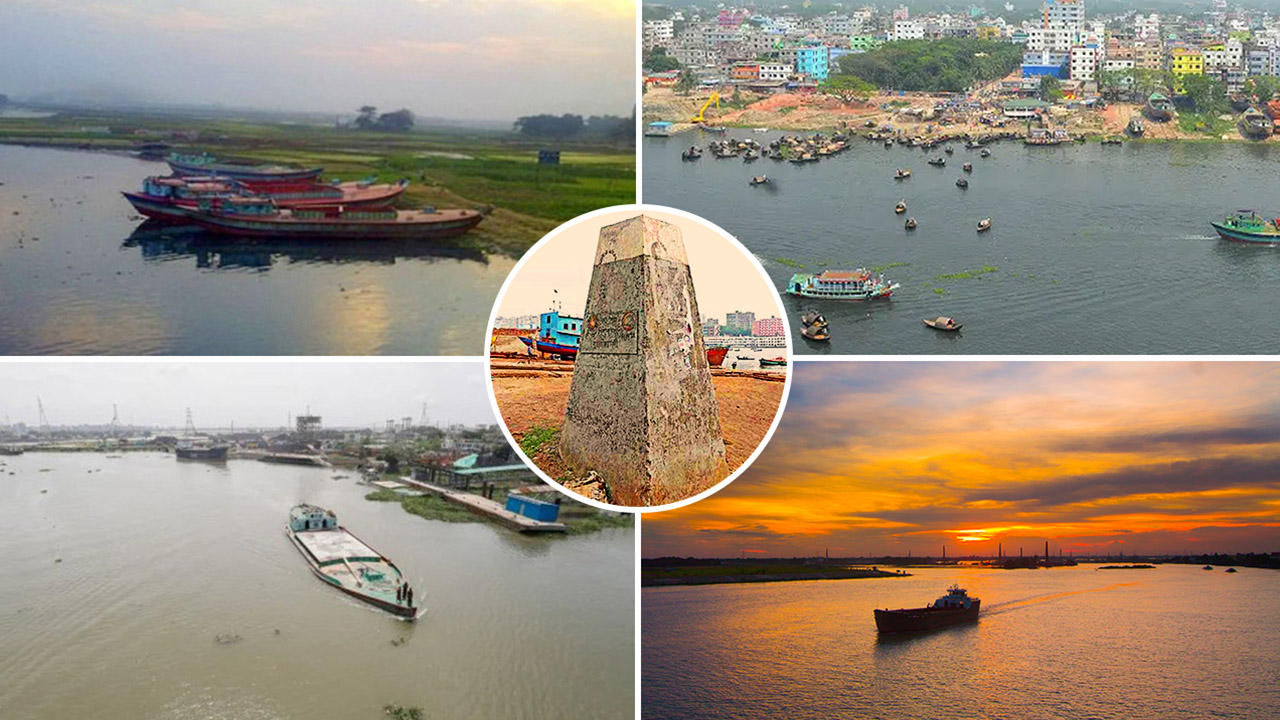
In 2009, the High Court issued a landmark order to protect Dhaka’s four major rivers. The order directed authorities to identify the original boundaries of the rivers and install permanent boundary pillars along their banks.
However, 17 years later, the 220-kilometer riverbanks of the Buriganga, Turag, Balu, and Shitalakshya rivers have not yet been fully secured. Nearly 1,000 boundary pillars still remain to be installed.
A total of 148 kilometers of riverbank still lacks any permanent protective wall, leaving large sections vulnerable to renewed illegal encroachment.
The project is being implemented by the Bangladesh Inland Water Transport Authority (BIWTA). According to the plan, the riverbanks were to be fully protected through three phases involving the construction of a 220-kilometer circular walkway and the installation of boundary pillars.
In the first phase, at a cost of Tk 142 crore, a 20-kilometer permanent guide wall (protective embankment), two eco-parks, and jetties were constructed in Shyampur and Narayanganj. In the second phase, approved in 2018, the targets included installing 7,100 boundary pillars and constructing 52 kilometers of walkways.
Earlier, between 2010 and 2023, BIWTA removed a total of 17,829 illegal structures in the Dhaka, Narayanganj, and Tongi river port areas, recovering vast stretches of riverbank land.
Abu Jafar Mohammad Shahnewaz Kabir, Supervising Engineer of BIWTA and Project Director, told Asia Post that under the second phase, approximately 6,300 pillars and 42 kilometers of walkways have already been completed. However, more than 1,000 boundary pillars still need to be installed in Fatullah, Gabtoli, Aminbazar, Rayerbazar, Kamrangirchar, Tongi, and Ashulia. Construction of three jetties has already been completed.
Officials claim that 91 percent of the project work has been completed. Environmentalists, however, argue that the remaining 9 percent constitutes the most complex and crucial portion of the project.
Land Disputes and Lack of Coordination
Land-related disputes and poor coordination among government agencies have been identified as the primary causes of the project's slow progress.
Project Director Abu Jafar Mohammad Shahnewaz Kabir said, “There were disputes over certain areas with the Bangladesh Water Development Board and the Dhaka North City Corporation. These issues have now been resolved. However, legal complications and court cases involving private landowners have caused work to stall in many locations.”
The third phase is expected to cover areas, including Narayanganj’s Bandar region and other sites currently tied up in legal disputes. A new Development Project Proposal (DPP) is being prepared for this purpose.
According to the project director, the next phase will focus on the remaining 148 kilometers of riverbanks in Keraniganj, Pagla, Madanganj, Demra, Kanchan, and Purbachal. However, due to existing homes and permanent structures, constructing continuous walkways in many places has become impossible.
Rising Costs, Limited Progress
The second-phase project, approved in 2018, has already undergone two revisions. Its original cost was Tk 848.55 crore, but after revisions, the budget has increased to Tk 1,276 crore.
Plans to include the project under the World Bank-funded Umbrella Investment Program have also failed to materialize. The project director explained that the government had intended to secure World Bank financing through the program, but no progress was made. As a result, the DPP is now being revised and will be resubmitted to the ministry.
What Experts Say
Alamgir Kabir, General Secretary of the Bangladesh Poribesh Andolon (BAPA), told Asia Post, “This historic court order came after environmental activists went to court. However, the government initially failed to properly demarcate the river boundaries. It then delayed installing the pillars, and even where pillars have been installed, it has failed to prevent illegal encroachment.”
He added, “Although the court declared these four rivers environmentally critical areas, the responsible agencies have not taken the necessary steps to make them completely pollution-free.”
Manzur Ahmed Chowdhury, former Chairman of the National River Conservation Commission, said, “Installing boundary pillars was an excellent initiative, and BIWTA deserves credit for it. However, the work has been delayed due to resistance from private landowners and business operators. The remaining work should be completed as quickly as possible.”
He further stated, “Protecting river boundaries alone will not save the rivers. They must also be freed from pollution, because pollution is gradually destroying them.”