
“If elected, I will remove bribery from city corporation”
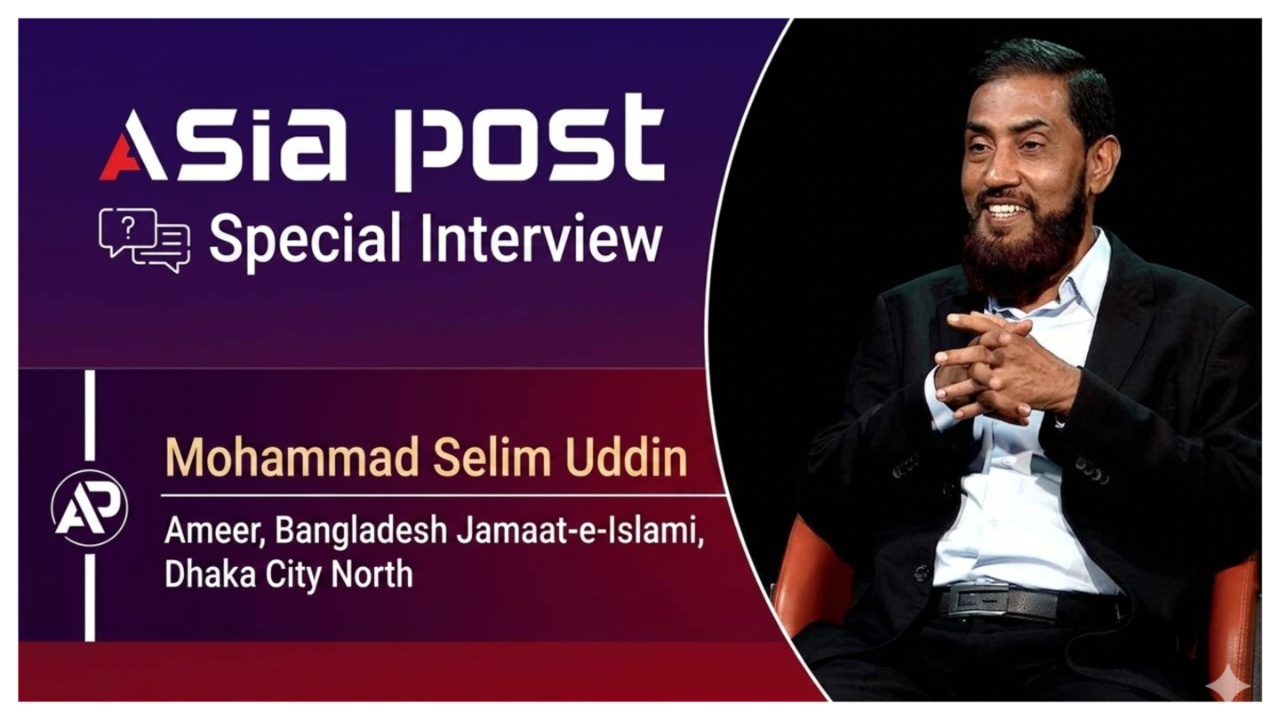
Mohammad Selim Uddin is the Ameer (chief) of the Dhaka North unit of Bangladesh Jamaat-e-Islami. He previously served as the central president of Islami Chhatra Shibir. Recently, Jamaat nominated him as its mayoral candidate for the Dhaka North City Corporation (DNCC). He recently appeared as a guest on Alapone, a regular program of Asia Post, where he spoke about Jamaat and Chhatra Shibir politics, Dhaka's urban challenges, and various contemporary national issues. The interview was hosted by Rahat Rupantor.
Asia Post: We'd like to begin with the story of your political journey. You once served as the central president of Islami Chhatra Shibir. How did your association with the organization begin, and what were the early stages of that journey like?
Mohammad Selim Uddin: When I was a sixth-grade student, some senior brothers from our locality used to call me over and ask about my studies and health. They spoke very kindly and wisely, and to me it felt almost magical. I was deeply impressed by their manners and behavior. Without even realizing it, I was drawn to them because of their good character and eventually joined Islami Chhatra Shibir. Since then, Shibir has played the most significant role in shaping and transforming my life.
For me, Chhatra Shibir represents a disciplined way of life. Members are encouraged to wake up before dawn, offer Tahajjud prayers if possible, and attend congregational prayers at the mosque. After prayers, they study the Quran and Hadith, read literature regularly, and engage in self-development.
During my student years, even when I spent time with friends in the afternoon after classes, our gatherings were highly constructive. We checked on one another, discussed our studies, and encouraged each other's growth. Shibir has guided my life every step of the way, and I consider that a special blessing from Allah.
Asia Post: You have been nominated as the mayoral candidate for Dhaka North City Corporation while also serving as the Ameer of Jamaat's Dhaka North unit. How are you managing the demands of both the election campaign and your organizational responsibilities?
Mohammad Selim Uddin: Being busy is generally a positive aspect of life. I find fulfillment in staying engaged. Those of us involved in Jamaat-e-Islami's politics believe our political activities are highly constructive. Our scope of work is extensive. What people see publicly is only a fraction—our actual work is at least ten times greater.
Not everything needs to be shared with the media. We have many internal activities, such as strengthening our moral and ideological foundation, engaging in in-depth study, teaching others through books, and carrying out various forms of humanitarian service. At present, we are busy with preparations for the city corporation election, developing new election strategies, and organizing field programs under the 11-party alliance. Altogether, it is a very busy time.
Asia Post: Could you explain in detail the different stages of becoming a worker, associate, and member of Islami Chhatra Shibir, as well as the organization's prescribed syllabus?
Mohammad Selim Uddin: You can think of Islami Chhatra Shibir as an educational institution with different levels, ranging from primary school to a master's degree. For new supporters, there is an introductory reading list designed to help them understand Islam, humanity, the country, and the world.
The syllabus for the Worker stage includes selected portions of the Quran and Hadith, along with literature by both local and international authors—including Hindu writers—to help members understand society and global affairs.
The Associate stage is comparable to the high school level. At this stage, the syllabus becomes more advanced, and members are expected to gain a deeper understanding of international affairs. They must pass both written and oral examinations.
Finally, to become a Member, one must study the entire Quran along with its meanings. In addition, members are expected to acquire in-depth knowledge of politics, economics, history, and the biographies of prominent figures. Even if someone never attends a mainstream educational institution, Shibir's curriculum, in my view, is sufficient to help them become an informed and capable individual.
Asia Post: Your organization is known for maintaining strict discipline regarding smoking and other addictive substances. How do you ensure that members follow these rules?
Mohammad Selim Uddin: Those who are associated with our organization lead disciplined lives. The question of drug use simply does not arise within our organization; in fact, members do not even smoke cigarettes.
We maintain this standard through a system of mutual communication and regular supervision. Responsible members keep track of whom individuals associate with and the environments they spend time in. Personal habits do not remain hidden. More importantly, the atmosphere within our organization is such that people cannot even imagine smoking cigarettes.
Asia Post: How do new students become involved with Chhatra Shibir? And regarding the oath that people often talk about, what commitments are actually made?
Mohammad Selim Uddin: Whenever we hold general meetings, tea gatherings, or orientation programs for new students, many students become convinced after listening to our speeches and either join Islami Chhatra Shibir immediately or at a later time. Our organizers also visit hostels and homes as part of our outreach.
Regarding the oath, it is a pledge made in the name of Allah—to follow the path of Allah and the Qur'an, stay away from prohibited (haram) acts, and take care of one's parents. We regularly monitor whether members uphold these values. If someone fails to maintain these standards, they may resign voluntarily, or the organization may remove them.
Asia Post: You served as the central president of Islami Chhatra Shibir for five consecutive sessions beginning in 2004. Looking back, how successful do you consider your tenure?
Mohammad Selim Uddin: It is difficult to judge one's own success. However, I can say that as central president, I always placed religion, the country, and the welfare of students above everything else. Rather than pursuing personal interests, I sincerely tried to work with the highest commitment to safeguarding Islam and the nation's interests. My colleagues are probably in a better position to assess how successful I was. What I can confidently say is that I never neglected my responsibilities.
Asia Post: Some people say that while Islami Chhatra Shibir has embraced modernity, Jamaat-e-Islami has not fully adapted to modern thinking. What is your view? In particular, what changes are leaders who came from Shibir bringing to Jamaat?
Mohammad Selim Uddin: Jamaat and Shibir operate in different spheres. Shibir works exclusively with students, whereas Jamaat works with everyone—from slum dwellers to the elite. At one time, Jamaat lacked sufficiently trained personnel, but now former Shibir leaders are leading Jamaat across the country. Therefore, there is no difference in terms of modernity or mindset.
Today, Jamaat is largely run by people who came through Shibir. The creative and innovative initiatives Jamaat has undertaken in Dhaka over the past few months clearly demonstrate that the organization is moving forward with a modern and timely approach.
Asia Post: What role do you play regarding those who finish student life but do not join Jamaat? And once someone joins Jamaat, how are responsibilities or positions assigned?
Mohammad Selim Uddin: We regularly keep track of how many members graduate from Shibir each year. We even try to locate those who left 20 years ago and encourage them to become involved again.
After entering professional and family life, many people lose momentum because of work or personal commitments. Nevertheless, we manage to reconnect with most of them. In Jamaat, the emphasis is on work rather than positions. Responsibilities include outreach, community service, and teaching the Qur'an to ordinary people. According to our philosophy, every individual has a responsibility. So, there is no room for anyone to remain inactive within the organization.
Asia Post: How did you personally carry out your responsibilities during the past 17 years of political adversity?
Mohammad Selim Uddin: The past 17 years were extremely busy. Today, we can hold a meeting with 300 people in one place. Back then, to speak with those same 300 people, we had to visit 30 different locations. The authorities were constantly monitoring us. However, by using modern methods and our own information network, we continued our organizational work while avoiding their surveillance. During the COVID-19 pandemic, we also conducted extensive activities through Zoom. Even our senior leaders adapted quickly to modern technology.
Asia Post: Could you describe Jamaat-e-Islami's role in the July 2024 movement and your personal experience during that period?
Mohammad Selim Uddin: Our role in the July movement was highly organized. Our Ameer formed a six-member committee. In coordination with Shibir, we met every day after the Fajr prayer to analyze the progress of the movement and issue instructions.
Personally, the authorities searched extensively for me. They even arrested our Secretary General, Professor Mia Golam Parwar, and pressured him to identify my residence. However, neither he nor his wife disclosed any information.
Since the northern part of Dhaka had the highest concentration of protest sites, I became one of their primary targets. On July 17, our Ameer returned from Umrah. He scheduled a meeting for July 18. When intelligence personnel surrounded the meeting venue, the Ameer came to my house at midnight. At around 1:00 a.m., he held the meeting there and instructed us that we should treat the families of those killed and injured as members of our own family, regardless of their political affiliation.
Asia Post: What kind of activities did your organization undertake to support those who were injured or killed during the movement?
Mohammad Selim Uddin: Following the Ameer’s instructions, we visited every hospital in Uttara. We initially provided Tk 100,000 in financial assistance to each family of those who were killed, which was later increased to Tk 200,000. We also covered all medical expenses for the injured. Even when the police and armed groups prevented injured people from receiving water, our workers risked their lives to stand beside them. From arranging funerals and burials to caring for the injured, we carried out every task with great care. Our members on the ground also provided logistical support, delivering food and water to the students participating in the movement.
Asia Post: After Jamaat-e-Islami and Islami Chhatra Shibir were banned on August 1, what was your decision?
Mohammad Selim Uddin: When we were banned, we held a Zoom meeting and decided that we would remain on the streets with all our strength and that we would not accept the ban. Hasina's decision was shortsighted. On August 2, we organized an unprecedented procession from Baitul Mukarram. On August 3, when students wanted to march on Ganabhaban, we advised them that it could be dangerous. Instead, we proposed a "Dhaka Siege" program on August 5 or 6. It was we who suggested bringing the program forward by one day to August 5. By the grace of Allah, we achieved victory.
Asia Post: Jamaat continues to face allegations over its role during the 1971 Liberation War. How much credibility do those allegations still have among the younger generation?
Mohammad Selim Uddin: The issue of 1971 has been used as a political tactic. We remember the freedom fighters with respect. Jamaat leaders opposed the breakup of Pakistan out of concern. They believed that after becoming free from Rawalpindi's rule, we might instead become subservient to Delhi. The allegations brought against them were not proven in court. The verdict in the case of A.T.M. Azharul Islam was later overturned by the court. The younger generation now understands these issues. Even the list of alleged collaborators prepared by the Awami League included the names of some of its own leaders. Therefore, there is no longer any opportunity to create division by invoking 1971. The 2024 movement was also aimed at realizing the aspirations of 1971.
Asia Post: There has been discussion about leadership changes at the grassroots level and the long tenure of Jamaat's amirs. What is your opinion on this?
Mohammad Selim Uddin: We hold internal elections every two years through secret ballots, and leaders are chosen through a democratic process. We have a strong team spirit. At one time, some leaders served for extended periods because of a leadership crisis, but that has now become less common. There is no infighting over positions within our organization. Everything operates through a disciplined system.
Asia Post: Is Jamaat now shifting toward popularity-based politics?
Mohammad Selim Uddin: Jamaat's politics has always been people-oriented. Where public welfare exists, popularity naturally follows. We seek the prayers and goodwill of the people through service. One of the beauties of Islam is standing beside people in service.
Asia Post: How do you view the performance of the former interim government and Jamaat's current relationship with the BNP?
Mohammad Selim Uddin: Some people within the interim government tried to misguide the Yunus administration. We had demanded a referendum. However, the BNP's position amounted to disregarding the opinion of about 70 percent of the people. There is no example anywhere in the world of a referendum result being ignored in this way. We have no personal conflict with the BNP. They are serving as the ruling party, while we are in the opposition. If they do good work, we will support them. If they act against the public interest, we will protest.
Asia Post: Could you tell us about Jamaat's financial management and the transparency of its funds?
Mohammad Selim Uddin: Islami Bank or Ibn Sina are not institutions directly owned by Jamaat. As for Jamaat's own funds, we appoint professional auditors. Audits are conducted two to three times a year, and the reports are submitted to the relevant bodies. Jamaat is probably the only political party that maintains strict financial transparency from the central level down to the ward level.
Asia Post: As a candidate for mayor of the Dhaka North City Corporation (DNCC), what are your specific plans?
Mohammad Selim Uddin: Our first goal will be to make the city corporation completely free of corruption and eliminate bribery. We will bring public services within easy reach through an integrated mobile application. To address waterlogging, we will recover abandoned canals and water bodies, conduct hydrological surveys, and develop a modern drainage system.
To reduce traffic congestion, we will introduce franchise-based bus services through route rationalization and build underground and above-ground parking facilities at major markets. Strict measures such as mechanical street sweeping and horn control will be implemented to combat air and noise pollution. We also plan to recycle waste to generate electricity and manufacture useful products.
Asia Post: What special initiatives have you undertaken for young people?
Mohammad Selim Uddin: I have already launched a platform called NagorikBa.net. Citizens can register there, and if they need a physiotherapist, an ambulance, or technical assistance, our quick response team arranges the required service promptly. If elected, we will establish a "Mayor's Startup Incubation Center" and a Qard Hasan (interest-free loan) Fund for young people. We will provide mentorship to keep young people from going astray and hold monthly town hall meetings with them.
Asia Post: Why does Jamaat announce its candidates long before the election? What is your position on using candidates' photographs in campaign materials?
Mohammad Selim Uddin: Announcing candidates early gives them an opportunity to interact with people and understand their problems. It is not just about seeking votes; it is also a way of listening to the public's hardships. As for using photographs in campaigns, it is a modern necessity. Voters have the right to know and recognize the person they are voting for. There is no easier way to introduce a candidate to the public than through photographs.
Asia Post: If another party forms the government, could that create difficulties in securing development funds or allocations?
Mohammad Selim Uddin: Members of Parliament have designated development funds that cannot be taken away. In fact, if the mayor belongs to the ruling party, the risk of corruption is greater. If Jamaat candidates are elected, they will ensure the proper and honest use of those funds, resulting in balanced development.
Asia Post: What are your expectations for the upcoming election?
Mohammad Selim Uddin: I want to have confidence in the transparency of the election. Together with the people, we are prepared to face any challenge. We are committed to delivering a modern and safe Dhaka.
Asia Post: Thank you very much.
Mohammad Selim Uddin: Thank you as well. I am grateful for the opportunity to convey our message to the people through your platform. I wish everyone well.