
'Memories of torture at DB Office still haunt me'
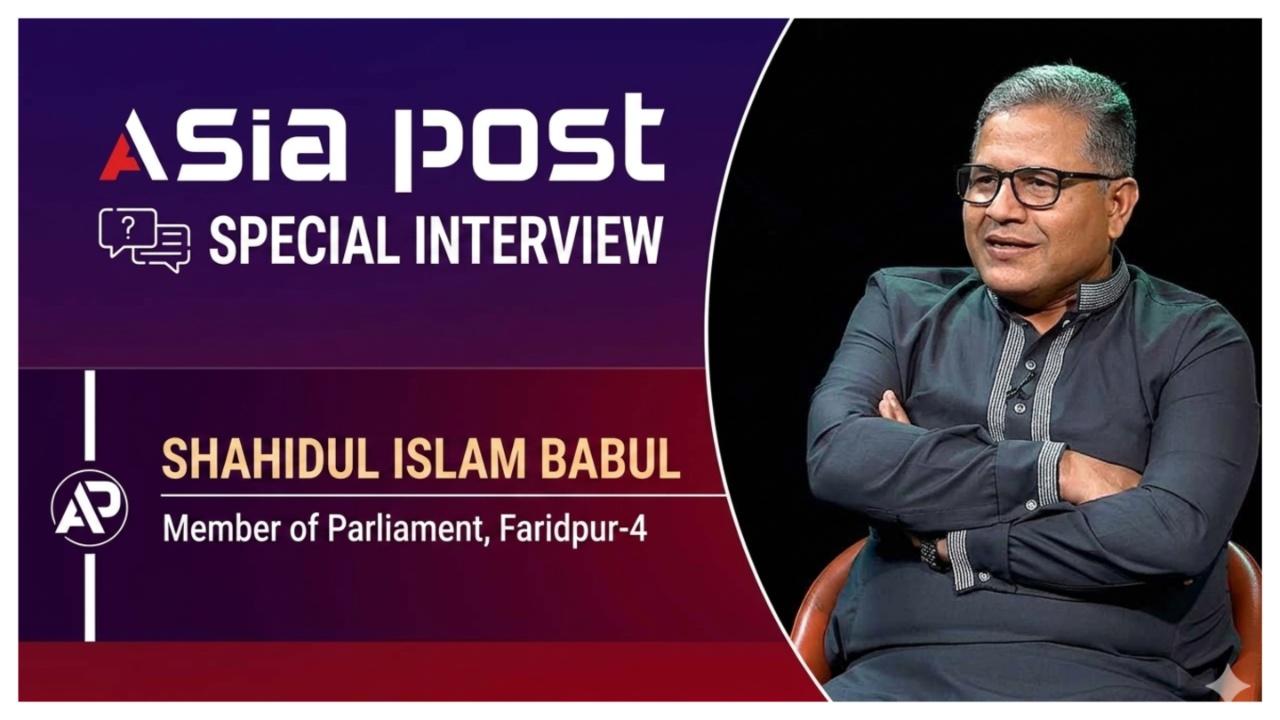
Md. Shahidul Islam Babul, Member of Parliament from Faridpur-4, is a former Senior Vice President of the central committee of the Jatiyatabadi Chhatra Dal (JCD) and currently serves as the General Secretary of the central committee of the Jatiyatabadi Krishak Dal.
After facing 128 political cases and being imprisoned numerous times during his political career, he now sits in Parliament. Recently, he appeared as a guest on Alapon, a talk show by Asia Post, where he spoke with Rahat Rupantor about his journey from grassroots politics and the country's current political landscape.
Asia Post: After overcoming years of political adversity, you are now a member of Parliament. How has life been since the political changes in July?
Shahidul Islam Babul: To be honest, I deeply miss the days when we were in the opposition. My political journey began during the military rule of Hussain Muhammad Ershad. As teenagers, we witnessed the massive student-led movement against Ershad, and it was through that movement that we received our political awakening.
In 1987, after passing my SSC examination from a remote village school, I enrolled at Rajendra College in Faridpur. At that time, Faridpur was at the heart of the anti-autocracy movement. Following the assassination of President Ziaur Rahman, many believed his party would not survive. But Begum Khaleda Zia took up the mantle, carrying forward the ideals and vision he had left behind. She came to the streets, won the people's overwhelming support, and in the 1991 election, when few expected the BNP to come to power, the people placed their trust in her leadership through a landslide victory.
During that period, countless young people joined the banner of the Jatiyatabadi Chhatra Dal, and I was one of them. Now that I sit in Parliament, I often find myself reminiscing about those days of struggle on the streets.
________________________________________
Asia Post: Your admiration for Ziaur Rahman seems deeply personal. Was there a childhood memory that shaped this attachment?
Shahidul Islam Babul: Absolutely. I have a wonderful childhood memory of President Ziaur Rahman. When I was in the second grade, he was passing along the highway beside our school. We had been instructed to stand by the roadside, dressed neatly, to welcome the President. He stopped his car and affectionately patted me on the head. That moment stayed with me and acted like a magnet throughout my life.
Later, when I was in the fourth grade, I noticed an unusually somber atmosphere at school. The teachers were deeply saddened, and classes were dismissed early. I later learned that President Ziaur Rahman had been assassinated in Chattogram. Although I was too young to understand politics at the time, I could sense the grief and anxiety among ordinary villagers. From then on, his ideals became deeply rooted in my heart.
________________________________________
Asia Post: How supportive was your family when you first entered politics?
Shahidul Islam Babul: Initially, my family had no idea that I was participating in Chhatra Dal processions.
It gradually became known after I was admitted to the University of Dhaka. At the time, my relatives and even my schoolteachers were not pleased. They believed that a bright and well-behaved student entering politics was heading down the wrong path. In those days, politics was widely associated with violence and hooliganism.
However, my father, who was a freedom fighter and always stood against injustice, never openly discouraged me. As a member of the Union Board, he had worked with President Ziaur Rahman on canal excavation projects. As a result, our family already held an anti-Awami League political outlook.
Over the years, I served on six consecutive central committees of the Jatiyatabadi Chhatra Dal, eventually becoming its Senior Vice President and Acting President. My bond with the student organization has become one of the deepest relationships in my life.
________________________________________
Asia Post: Could you share one of the most painful memories from your political life while you were a student at the University of Dhaka?
Shahidul Islam Babul: There are many, but being forced to leave my residence hall remains the most painful. I was a student at Kabi Jasimuddin Hall. After the Awami League came to power in 1996, they gradually took control of the university halls. Around 1997–98, we were forced to leave due to the oppression of the Chhatra League.
My room was set on fire, and I had to leave without being able to take any of my belongings. Losing the hall life—the friendships, conversations, and atmosphere—was heartbreaking. I later moved into a rented mess, where the facilities were nowhere near what the hall had offered. Adjusting to that new life took a long time.
Still, the sacrifices I made for politics now feel far greater than any rewards I have received.
________________________________________
Asia Post: Your arrest during the 2018 election drew significant public attention. Could you briefly describe what happened?
Shahidul Islam Babul: It was a dramatic incident. In December 2018, as I was getting ready at home, a team from the Detective Branch (DB) entered my house pretending to be BNP activists without identifying themselves. They went straight into my bedroom.
My wife acted quickly and helped me escape through the back door. I fled to the rooftop of a neighboring house and hid there. Unable to find me, they detained my nephew and subjected him to torture.
After spending several days in hiding, I took shelter at a friend's house. I didn't have a mobile phone, but I made a single phone call to someone in my constituency using another person's phone.
The police tracked that call and arrested me in what I would describe as a movie-style operation.
After my arrest, I was taken to the DB office, where I was suspended from the ceiling and physically tortured. Even today, the memories of those horrific days send shivers down my spine. I spent six months in prison following that incident.
________________________________________
Asia Post: Do you see any difference between student politics during your time and student politics today?
Shahidul Islam Babul: The difference is like night and day. There were conflicts on campus during our time too, but politics was marked by decency and mutual respect. We used to sit together at Madhur Canteen. Even though we were leaders of Jatiyatabadi Chhatra Dal, we maintained good personal relationships with leaders of Chhatra League.
No one would physically attack political leaders. But the political culture the Awami League has fostered over the past 15–16 years is disgraceful. Chhatra Dal has been attacked 476 times. The way our leaders, including Sultan Salauddin Tuku, were assaulted is beyond description.
There is hardly any tolerance left in politics today. Dhaka University was once a cradle of free thinking and democratic practice, but the Awami League turned it into a hub of drugs and criminal activities. Student politics should be dignified, graceful, and civilized, but those values are gradually disappearing.
________________________________________
Asia Post: You are now the General Secretary of the Jatiyatabadi Krishak Dal. Could you tell us how you transitioned from being a student leader to leading the farmers' wing?
Shahidul Islam Babul: I come from a large farming family. We had five pairs of plough oxen, and meals for our joint family of 35 to 40 members were cooked in a single pot. I grew up witnessing the Nabanna harvest festival and the struggles of farmers.
I know how farmers are deprived of fair prices for their produce. Middlemen exploit the fruits of their hard work. Our Faridpur region produces a significant share of the country's onions, along with Rajbari. Yet farmers often fail to receive fair prices, and their crops end up rotting. Although farmers are the backbone of this country's economy, they continue to be neglected.
I told our Acting Chairman that I wanted to work for marginal farmers. The very purpose of establishing the Krishak Dal under Shaheed President Ziaur Rahman was to organize farmers and make them aware of their rights. That is the mission I am pursuing today.
________________________________________
Asia Post: What do you consider to be the Krishak Dal's most significant achievements since its establishment?
Shahidul Islam Babul: Since its founding in 1980, the Krishak Dal has been working to protect farmers' rights. Our founding president was Justice Abdus Sattar. Later, leaders such as Mannan Bhuiyan and Mirza Fakhrul Islam Alamgir led the organization.
Perhaps we have not yet been able to fully establish our political presence among farmers, but we are trying. During the recent movement, we brought thousands of farmers onto the streets in protest, and many of our leaders and activists sacrificed their lives.
When the BNP was in power, agricultural loans of up to Tk 5,000 were waived, and land taxes on up to 25 bighas of farmland were abolished. These were landmark decisions for farmers. Looking ahead, we are planning policies to ensure that farmers receive fair prices for their produce and that agricultural inputs remain affordable.
________________________________________
Asia Post: As the Member of Parliament for Faridpur-4, what are your key development plans for your constituency?
Shahidul Islam Babul: Drug abuse has become a serious problem in my constituency. I have made it clear that drug traffickers have no political affiliation. I have instructed the administration to take strict action against them without exception.
I have even set an example by handing over members of my own party to the police if they were involved in drug trafficking. In addition, I will strongly advocate in Parliament for the establishment of a trauma center and an agricultural university in my constituency.
My constituency includes three upazilas—Bhanga, Sadarpur, and Charbhadrasan. River erosion is a major challenge in these areas. I do not want to be people's "godfather"; I want to be someone they can truly rely on. Ensuring public safety and good governance is my primary goal.
________________________________________
Asia Post: Do you believe Bangladesh's political culture has changed since the July 2024 mass uprising?
Shahidul Islam Babul: Yes, it certainly has. Before August 5, there was virtually no political decorum in the country. Senior leaders routinely made offensive and indecent remarks about their opponents.
That environment no longer exists. There is now a greater sense of accountability among people. From the Prime Minister to the police force, everyone understands that they are answerable for their actions. Since the events of July, we have promoted a message of peace rather than revenge. Tarique Rahman has clearly stated that there should be no politics of retaliation.
As a result, a culture of avoiding political vengeance while maintaining peace and stability has begun to take shape. Although some members of the younger generation may still display a degree of arrogance, they are gradually realizing that the country can move forward only by working together with experienced politicians.
________________________________________
Asia Post: Finally, how do you see your political future?
Shahidul Islam Babul: Politics should always be about serving the people. I want educated and capable individuals to enter politics. If good people stay away, bad people will end up governing society.
This country belongs to all of us. Governments will come and go, but our love for the country must remain constant. Political differences are natural, but nothing should be done that harms the nation. Throughout my life, I have remained committed to principles and ideals in politics. Where I will be in the next ten years is for my party to decide. However, I hope to play a positive role in national politics.
I believe that through love for people and patriotism, we can build a better society. Let me conclude with a line by Shankar: "Even with all my love, my longing remained unfulfilled; this life was not enough. Alas, why is life so short?" In the end, what truly matters is having love for humanity.