
Will Lebanon Agreement with Israel pave way for next war
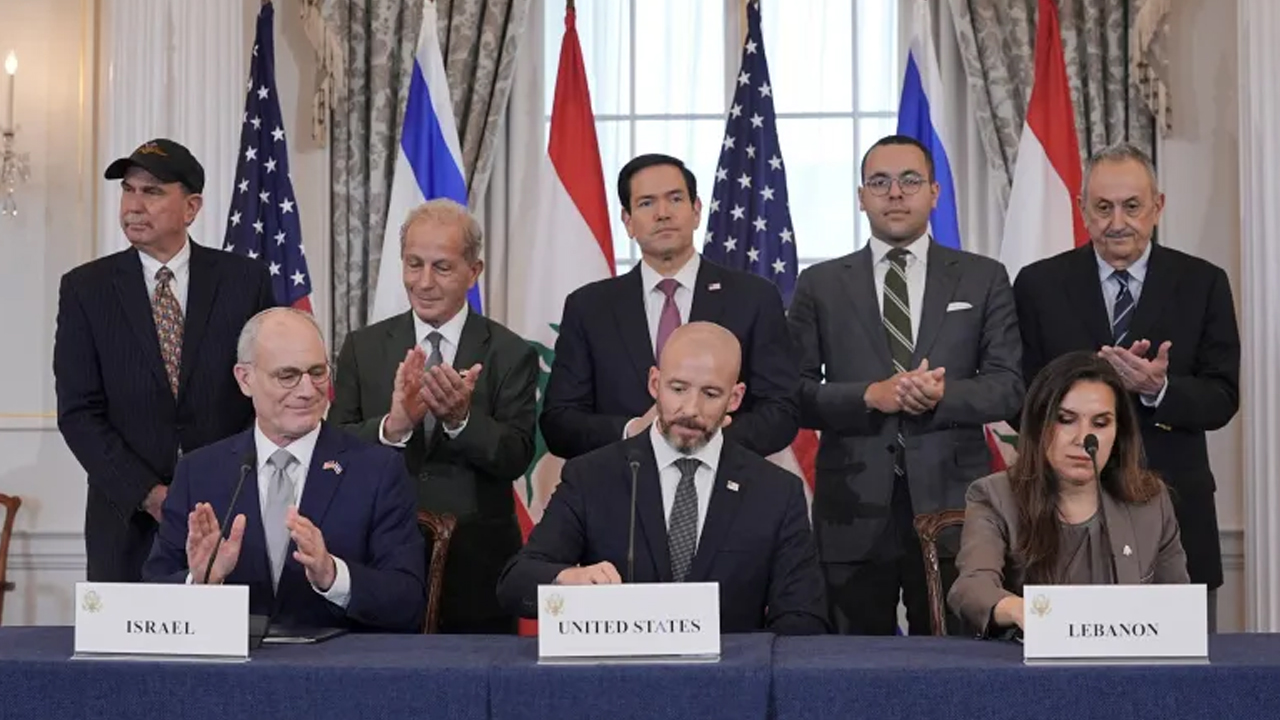
After months of war, immense pressure, and prolonged diplomatic efforts, Lebanon has finally reached an agreement with Israel. However, the decision has triggered an intense backlash. Hezbollah, its allies, and a significant segment of Lebanon's political establishment have condemned the deal. Ordinary citizens have taken to the streets in protest, while the media has mounted fierce criticism.
The agreement suffers from numerous flaws. It is not only unrealistic and politically dangerous but also constitutionally questionable. Most alarmingly, however, it may create the conditions for another war—one for which Lebanon itself could ultimately be blamed.
An 'Impossible' Agreement
For decades, Israel has benefited from vaguely worded interim agreements. The Oslo Accords were one such "Declaration of Principles." Core issues—including borders, settlements, Jerusalem, refugees, and sovereignty—were deliberately left unresolved with the promise that they would be addressed later.
That "later" never came. Instead, Israel used the interim arrangement to advance its own interests, expand its occupation, entrench apartheid, and ultimately blame the Palestinians for failing to fulfill conditions that were never fully within their control.
Lebanon is not Palestine. Their circumstances and the nature of their agreements differ. Nevertheless, the diplomatic strategy employed in both cases shares troubling similarities.
While Lebanon and Israel have declared an end to their conflict, they have not reached a final settlement. Although the framework appears flexible on the surface, it is more likely to become a trap.
The framework Lebanon has accepted is nearly impossible to implement under current conditions. The Lebanese state cannot simply issue government orders and replace Hezbollah.
Hezbollah's weapons are not merely a military reality; they are tied to broader political questions, including Lebanon's defense strategy and the state's longstanding inability to protect its own territory. A signature on a document in Washington cannot dismantle this deeply rooted structure overnight.
Meanwhile, the Lebanese Armed Forces are facing severe challenges. They lack sufficient funding, are overstretched, and are politically constrained.
Moreover, the army depends heavily on foreign military assistance, the scope of which is largely determined by Israel and the United States. Under such circumstances, it cannot suddenly become a fully sovereign and capable national defense force.
In essence, Lebanon is being asked to demonstrate sovereign authority precisely where it is weakest. It is expected to control armed groups it cannot defeat and negotiate with an adversary it cannot deter. The country has accepted obligations whose implementation depends on external actors that place little value on Lebanon's sovereignty.
Constitutional Challenges and Strategic Delay
The agreement's most dangerous provisions extend beyond the battlefield. It requires both sides to refrain from taking "hostile" or "adverse" actions against one another in international political or legal forums. This provision is deeply concerning for Lebanese citizens, victims of war crimes, and advocates of international law.
Lebanon is no military match for Israel. Its remaining leverage lies in diplomacy, legal action, and politics. If those avenues are also closed in the name of "de-escalation," Lebanon will be left virtually powerless. Blocking access to institutions such as the International Criminal Court (ICC) would deprive Lebanon of its last meaningful tool.
The agreement also raises a serious constitutional crisis. Facing strong domestic opposition, Lebanon's president and prime minister may attempt to portray the declaration as merely a "political understanding" rather than a legally binding document.
Yet changing its label does not alter its substance. If the document addresses issues such as war, peace, borders, international obligations, and national security, it cannot be dismissed as a routine diplomatic statement.
Lebanon's Constitution does not grant any individual the authority to make such commitments unilaterally. International agreements require institutional approval. Matters involving war, peace, and national security fall under the jurisdiction of the Council of Ministers. Neither the president nor the prime minister alone can make decisions of such magnitude.
A simple "letter of intent" cannot bypass the constitutional safeguards of the Lebanese state. The Constitution obliges the state to preserve its territorial integrity. Consequently, no declaration can legitimize an Israeli military presence on Lebanese soil. Likewise, conditioning Lebanon's sovereignty on Hezbollah's disarmament is constitutionally indefensible.
This is precisely why the agreement has become politically explosive. Hezbollah, the Amal Movement, and other opposition groups are expected to use every available mechanism to block it. They will argue that Cabinet approval is constitutionally mandatory. They may also portray the deal as an attempt to normalize relations with Israel.
Opposition parties are likely to demand explicit guarantees regarding the withdrawal of Israeli forces. They will resist any effort to restrict Lebanon's right to pursue legal action against Israel.
Through parliamentary committees, constitutional debates, and bureaucratic procedures, they could effectively stall the entire process. While political deadlock is usually viewed negatively in Lebanon, under the current circumstances such delays may actually represent the least dangerous option.
Setting the Stage for the Next War
The fate of the agreement will not ultimately be decided in Beirut. Rather, it depends on broader regional dynamics involving the United States, Iran, and international mediators.
More important than Lebanon's signature is what Tehran instructs Hezbollah to do, what guarantees Washington provides, and how much Israel ultimately gains. Whether the understanding between the United States and Iran endures will largely determine whether the region descends into renewed conflict.
At present, the regional political environment matters far more than the wording of the declaration itself. If the broader regional process survives beyond the initial 60-day period, Hezbollah may choose to observe developments rather than immediately return to confrontation. But if those negotiations collapse, this paper agreement alone will not prevent another war.
By signing the agreement, the Lebanese government may believe it is buying time. It may hope that, over time, the document will simply fade into history. Yet what is written in the agreement could have lasting legal and political consequences that far outweigh any temporary political advantage.
Pleasing U.S. President Donald Trump may buy Lebanon a few months. It could provide time to navigate Israeli elections or await changes in U.S. domestic politics. The strategy may be intended to balance Hezbollah, Israel, Washington, and Tehran. But Lebanon will pay a heavy price for pursuing that course.
This agreement is far more than a symbolic document; it carries profound legal and political implications. In reality, Hezbollah is unlikely to comply with its terms unless instructed to do so by Iran. If Hezbollah refuses, Israel will hold the Lebanese government responsible.
Similarly, if Lebanon's under-resourced army cannot adequately deploy along the border, Israel will portray that as another Lebanese failure. If Lebanon seeks legal action against Israel in international courts, Israel may characterize it as a breach of trust. Should Lebanon reject any Israeli security demands, Israel will claim that Lebanon is unwilling to pursue peace.
For these reasons, the declaration is unlikely to prevent another war. Instead, it creates a political and legal framework that could later serve as justification for a new Israeli military campaign against Lebanon.
The greatest tragedy is that, after many years, Lebanon has finally been presented with an opportunity to stand on its own as a sovereign state. For decades, Israel has violated Lebanon's sovereignty.
Hezbollah has hollowed out that sovereignty from within. Regional powers have exploited Lebanon for their own strategic interests, while the country's political leadership has repeatedly failed to uphold its responsibilities.
What Lebanon truly needed was a strong national army, robust constitutional institutions, an effective defense strategy, and meaningful state accountability. Instead of defining genuine sovereignty, however, the country has embarked on a path that exposes its existing weaknesses for the world to see.
Author: Sami Halabi is the Policy Director at Badil – The Alternative Policy Institute, a Beirut-based think tank.