
A Policy Analysis on the Training of External Academic Auditors by BAC


The quality assurance in higher education has changed from the usual administrative compliance exercise to a strategic driver for socio-economic development and international competitiveness.
The effectiveness of external quality assessment in the construction of higher education ecosystems depends on the technical competence, ethical foundation and methodological precision of academic auditors.
The paper discusses the strategic alignment of auditor training, institutional digitalization and outcome-based accreditation frameworks in Bangladesh with the Bangladesh Accreditation Council’s professional development initiative on 3 November 2026 as a main case study.
This study looks at a transition from long-term capacity-building projects to targeted refresher interventions to understand how sustained professional development improves evaluation standards.
The analysis reveals the double impact mechanism of Outcome-Based Education and the Bangladesh National Qualifications Framework on graduate employability through the external peer review that links academic outcomes with the needs of the labor market.
Higher education systems in developing countries are challenged to expand access while maintaining high-quality standards. In Bangladesh, the Bangladesh Accreditation Council Act, 2017 was passed, a crucial statutory step toward formalizing quality assurance.
Under this legal framework Bangladesh Accreditation Council was constituted for regulation, evaluation and accreditation of academic programs and institutions throughout the country. The regulatory capacity of the Council is backed by a multidisciplinary pool of 151 academic auditors in the fields of engineering, agricultural sciences, business, law, humanities and basic sciences.
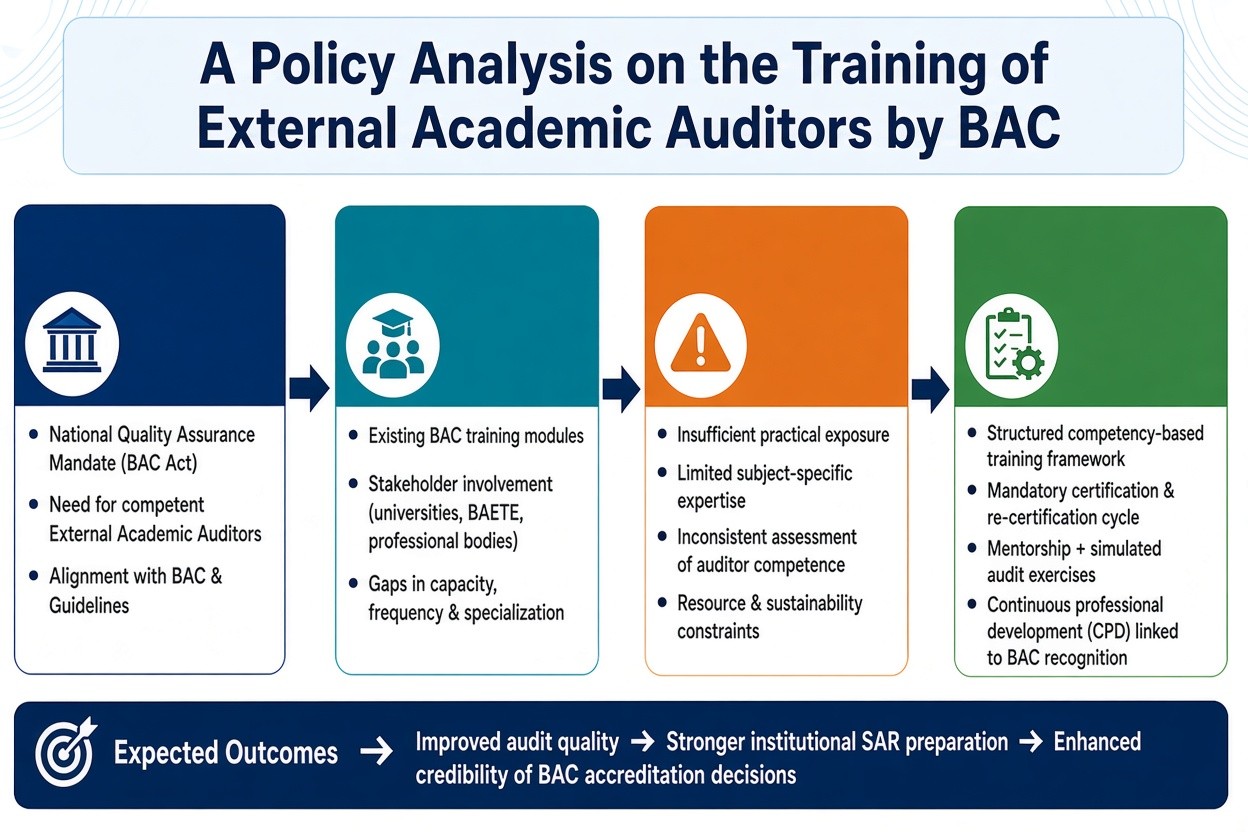
The credibility of the entire national accreditation system depends on the objectivity, methodological consistency and ethical integrity of these auditors. External quality assessment is basically peer-based review.
The Bangladesh Accreditation Council was held a focused training for its academic auditors at the International Mother Language Institute in Dhaka on November 3, 2026. Professor A. K. M. Monirul Islam set the tone of the event by stating that rigorous academic auditing is the main safeguard for institutional standards and public confidence.
This is part of a larger movement toward ongoing professional development to ensure that evaluator practice keeps up with the evolution of national standards.
External quality assessment structure should provide a balance between ethical governance and rigorous field methodology. The Policy on Management of Conflict of Interest and Confidentiality was presented by Full-time Member Professor Dr. Md. Wakilur Rahman in the Technical sessions.
He instituted ethical boundaries, mandatory disclosures before evaluation, and non-disclosure protocols to avoid bias and protect institutional data. The Council’s explicit provisions for past institutional cross-appointments, joint research and consultancy arrangements, ensure that auditors are objective evaluators, not subjective critics or prescriptive consultants.
In a session on improving external quality assessment during site visits, focusing on field implementation, Full-time Member Professor Dr. Md. Shah Amran elaborated on this ethical framework.
The empirical core of the evaluation is constituted by site visits. It is necessary for evaluators to go beyond the paper trail and systematically verify the evidence of institutional effectiveness.
Effective site visits require data triangulation of institutional Self-Assessment Reports with direct observations of classroom instruction, laboratory facilities, graded student artifacts, and interviews with faculty, students and employers.
Auditors are trained to give constructive exit briefings and reports that distinguish minor administrative lapses from major systemic deficiencies and that ensure evaluation leads to actionable institutional improvement.
The governance of accreditation was also collaborative due to the contributions of senior members of the Council.
Full-time Member Professor Dr. Ahmed Abdullah Jamal and Full-time Member Md. Emdadul Haque stressed the need for inter-departmental cooperation to maintain the countrywide standards of accreditation.
In his Speech of the Chair, Council Chairman Professor Dr. Md. Akhter Hossain Khan visualized the quality assurance by positioning well-trained auditors as the frontline ambassadors of educational excellence. An interactive open discussion was facilitated by the Deputy Director Dr. Farzana Sharmin where participants shared their field experience and challenges of operations and enhanced their shared community of practice.
May I remember my nostalgic training program attended at AIT extension. Selected academics have undergone intensive 21 days residential training at the Asian Institute of Technology Extension, Thailand under the World Bank funded Higher Education Quality Enhancement Project.
That foundational initiative led to the establishment of Institutional Quality Assurance Cells in universities, and introduced the ideas of outcome-based learning, self-assessment techniques and peer-review protocols.
The current half-day refresher model is an efficient vehicle for ongoing calibration, but the long duration programs established the initial foundation for a national quality culture.
This allows experienced auditors to remain current with the latest policies, digital frameworks and assessment rubrics without interrupting their teaching commitments.
Strong digital infrastructure is the translation of accreditation for many institutions. Professor Farheen Hassan, External academic Auditor, said that digitalization is not just an administrative requirement but a strategic enabler of transparency, efficiency and continuous improvement.
Universities today are turning more to enterprise software platforms to track internal quality measures, prepare for accreditation, and push the reach of global electronic libraries and journals to faculty and students alike.
Additionally, certain specialized software solutions, such as AI platforms, are starting to assist institutions in mapping Course Learning Outcomes to Program Learning Outcomes and broader national qualification descriptors. These electronic instruments help in preparing the Self-Assessment Reports and increase the accuracy of data during audits.
Thoughtfully integrated, technology helps organize complex pedagogical data, enabling evidence-based evaluation. This allows the auditor to focus on intellectual rigor, critical thinking, and student achievement.
The most important value of higher education accreditation is that it can promote socio-economic development and improve the employability of graduates.
The council is working under Bangladesh Accreditation Council Act 2017 to bring the higher education at per with Bangladesh National Qualification Framework.
This involves an alignment with Outcome-Based Education, where the measures to assess the universities are shifting away from input measures such as size of facilities or hours of lectures to measurable learning outcomes such as critical thinking, complex problem solving, collaboration and digital proficiency.
This shift affects the supply and demand side of the labor market. On the supply side, auditing programs against stringent learning outcomes means that universities are producing work-ready graduates who can immediately contribute to the workplace on graduation.
On the demand side, an accreditation mark is a reliable signal of quality to the employers, reducing information asymmetry and screening costs of candidates.
Chairman Professor Dr. Md. Akhter Hossain Khan said the graduates from the accredited programs have a unique advantage in the job market and the institutions that do not follow this quality parameters may put their graduates at a disadvantage in terms of competition.
The Plan-Do-Check-Act cycle also supports continuous institutional improvement, where accreditation is a process of self-assessment and strategic growth.
To maintain a credible accreditation system, continuous investment in the capabilities of auditors in several key operational areas is needed. Auditors need to apply standardized rubrics uniformly to remove evaluator bias and ensure fairness across a variety of disciplines.
They require a deep understanding of evaluation frameworks that unpack curriculum designs, governance systems and evidence of student learning, not just superficial checks.
Professional communication skills are also very important, allowing auditors to conduct interviews with respect and give constructive input that contributes to institutional growth, while upholding standards.
The experienced evaluators also must have analytical discrimination to distinguish minor procedural errors from major internal quality assurance failures, so that institutional resources are focused on high impact corrective actions.
Finally, as educational technologies and teaching models evolve, continuous professional development helps to ensure that auditors are kept up to date with modern pedagogical trends, hybrid learning environments and international best practices.
Four quality assurance frameworks operate in different ways and have high impact on different academic disciplines and institutional priorities within the tertiary education system of Bangladesh. QS (Quacquarelli Symonds) is dedicated to global university rankings and rating systems for institutional branding and international visibility.
It measures quality mainly by the reputation of the institution among academics and employers, the impact of research citations, faculty-to-student ratios and international diversity.
A strong performance in QS directly enhances the prestige of an institution, attracts international students and partners and strengthens the overall branding of a university in a competitive higher education market. ACBSP is targeted at business, accounting and management programs in business education.
Its quality metrics are focused on student-centered classroom instruction, continuous improvement processes, and measurable practical learning outcomes. ACBSP accreditation is highly valued by professionals and is often sought after by corporate HR departments and business schools that want graduates that are ready for the workplace.
Specifically, BITE / Medical Training is focused on clinical management and tropical medicine for public health and frontline clinical readiness. Quality is measured through rigorous hands-on medical protocols, compliance with national clinical guidelines and demonstrated competency in real-world patient care environments.
The orientation is immediately useful in a practical way which is essential to the medical professionals working in the healthcare system of Bangladesh. The Washington Accord is the international yardstick for undergraduate engineering qualifications.
The program is built on an Outcome-Based Education (OBE) model, ensuring that Bangladeshi engineering graduates meet globally recognized standards, and enable professional mobility and borderless practice across signatory countries.
Policy makers should institutionalize annual refresher workshops on emerging educational technologies and evolving audit methodologies to maximize the impact of higher education accreditation. The end-to-end digitization of the accreditation process from the submission of the report to the reporting of the audit will further improve the integrity and efficiency of the data processing.
Furthermore, the external review teams will involve industry experts to ensure that the program learning outcomes are aligned with the changing needs of the economy and workforce.
Longitudinal studies that follow graduates of accredited programs into the workplace will also provide important empirical evidence to guide future policy decisions.
To summarize, the training program of Bangladesh Accreditation Council is a good example that targeted auditor development is a high leverage approach in advancing quality assurance in higher education.
The Council builds a self-sustaining quality ecosystem through ethical governance, improved site visit practices, strategic digitalization and outcome-based evaluation.
This holistic framework guarantees the protection of academic standards and at the same time matches graduate competencies with socio-economic needs thus ensuring that higher education institutions produce skilled, adaptable and highly employable citizens who can make meaningful contributions to national development.
To improve quality assurance, the accreditation should be given only after a thorough assessment based on evidence and for a fixed period of five years. The period provides for timely reassessment and meaningful recognition of institutions.
The phased approach with timeframes fosters continuous improvement and maintains the long-term credibility of the accreditation system.
___________________________________________________
About the author: Prof.Dr.Muhammad Mahboob Ali is External academic auditor, BAC, Economist, Management specialist and IT and Entrepreneurial expert