
Middle East Eye Column : Are gulf states looking for an alternative to US
The impact of war is not confined to military outcomes alone. At times, war reshapes the entire geopolitical landscape of a region.
Two historical examples illustrate this point. Iraq's invasion of Kuwait in 1990 made the Arab world heavily dependent on the United States' security umbrella. Conversely, the U.S.-led invasion of Iraq in 2003 gave rise to prolonged sectarian conflicts across the Middle East, shaping the region's trajectory for nearly two decades.
The recent U.S.-Israeli war against Iran may likewise mark the beginning of another major transformation. The conflict has highlighted one crucial reality: Washington's ability to guarantee the security of its Gulf allies has clear limitations. As a result, regional powers are increasingly seeking new forms of coordination and partnerships to navigate an increasingly unstable Middle East.
Signs of an emerging alignment are already visible among Saudi Arabia, Turkey, Egypt, and Pakistan. These countries have begun adopting more coordinated positions on various regional crises than in the past.
At the same time, another bloc is strengthening on the opposite side, consisting of Israel, the United Arab Emirates (UAE), India, Greece, Cyprus, and Ethiopia.
The war against Iran has delivered an important lesson to the Gulf states: the security architecture that has dominated the region for decades has revealed significant weaknesses.
For years, the United States has invested heavily in military bases, early-warning systems, and missile defense throughout the Gulf, presenting itself as the region's ultimate security guarantor.
However, the conflict demonstrated that an American military presence alone cannot shield Gulf states from the consequences of regional wars. On the contrary, hosting U.S. forces can expose these countries to severe economic and security risks.
For example, Iran's attack on Qatar temporarily disrupted nearly one-fifth of the country's liquefied natural gas (LNG) export capacity.
This does not mean that Gulf states are preparing to abandon Washington anytime soon.
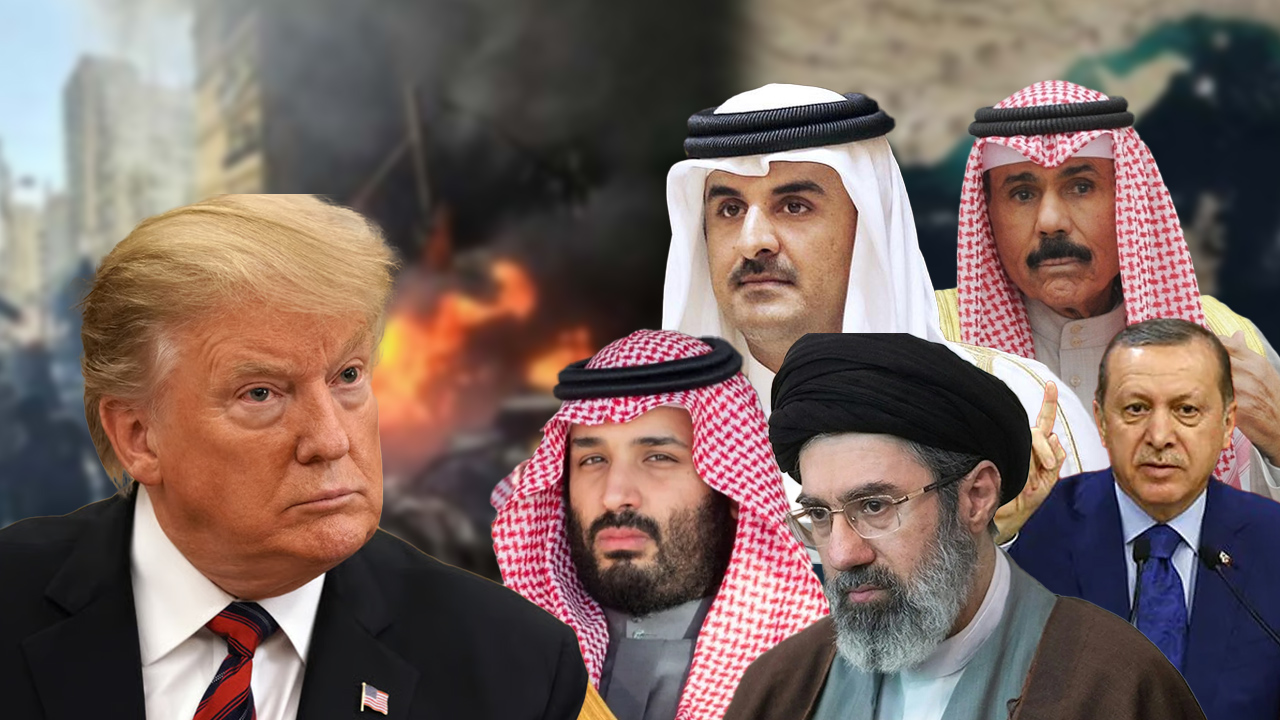
At a meeting in Doha, Qatar's Emir Sheikh Tamim bin Hamad Al Thani joined Saudi Crown Prince Mohammed bin Salman and other Gulf leaders for discussions.
Such a shift remains highly unlikely in the near future. Nevertheless, Gulf governments are increasingly seeking to reduce their overwhelming dependence on the United States by exploring alternative or supplementary security arrangements.
Political and Security Cooperation
The growing coordination among Riyadh, Ankara, Cairo, and Islamabad is particularly noteworthy. Each country brings distinct strategic strengths to the table.
Saudi Arabia possesses immense financial resources.
Turkey has a sophisticated and rapidly expanding defense industry.
Egypt offers substantial military capabilities and unmatched geostrategic importance. Pakistan contributes political influence, military strength, and nuclear capabilities.
Together, these assets could provide a solid foundation for closer political and security cooperation. That said, it would be premature to describe this emerging alignment as a fully institutionalized alliance. These countries have a long history of mutual distrust and rivalry, while their strategic priorities do not always converge.
Deep suspicion remains a defining characteristic of Middle Eastern politics. Governments in the region often formulate policy based on immediate crises and short-term calculations rather than long-term strategic planning.
Recent history offers several examples.Saudi Arabia and Turkey found themselves at odds during the 2017 blockade of Qatar.
Likewise, relations between Egypt and Turkey deteriorated sharply after the military overthrow of former Egyptian President Mohamed Morsi in 2013. The two countries also clashed over Libya.
Meanwhile, Israel appears to be constructing a new network of strategic partnerships.
During the mid-20th century, Israel pursued what became known as the "Periphery Doctrine," seeking alliances with non-Arab states surrounding the Arab world to offset Arab hostility.
Today's strategy is an updated and expanded version of that doctrine. It extends from the Horn of Africa to the Eastern Mediterranean and the Indian Ocean, integrating security, technology, and economic interests into a single strategic framework.
The United Arab Emirates has become one of the central pillars of this network. Since signing the Abraham Accords in 2020, Abu Dhabi and Tel Aviv have significantly expanded cooperation in maritime security, technology, and infrastructure.
India has emerged as another key component through the I2U2 grouping, which formally connects India, Israel, the UAE, and the United States.
Likewise, the India–Middle East–Europe Economic Corridor (IMEC) complements Israel's ambition to transform its ports into major transit hubs linking Asia and Europe.
India is already one of Israel's largest arms customers. According to the Stockholm International Peace Research Institute (SIPRI), approximately 34 percent of Israel's arms exports between 2020 and 2024 were destined for India, making it the single largest importer of Israeli weapons during that period.
A New Network of Partnerships
Greece and Cyprus form the western flank of Israel's emerging strategic network.
Following Israel's deadly raid on the Gaza-bound aid flotilla Mavi Marmara in 2010, relations between Turkey and Israel deteriorated dramatically. Since then, Israel has developed strategic partnerships with Greece and Cyprus in energy development and maritime security.
These partnerships also serve as a counterweight to Turkey's influence in the Eastern Mediterranean while complementing the broader economic initiatives involving the UAE and India.
Further south, Ethiopia and Somaliland are assuming growing geopolitical significance.
Ethiopia seeks direct access to the sea, while Somaliland continues its campaign for international recognition as an independent state.
Israel has also intensified its focus on the region after Houthi attacks during the Gaza war, seeking to secure its maritime routes and counter threats in the southern Red Sea.
Consequently, the strategic interests of Ethiopia, the UAE, and Israel have increasingly converged in the Red Sea and the Horn of Africa.
However, Cairo, Riyadh, and Ankara view these developments as posing significant challenges to their own strategic interests.
Even so, it would be mistaken to conclude that the Middle East is dividing into two rigid and opposing blocs.
History shows that durable alliances in the region are notoriously difficult to sustain.
Mutual distrust remains widespread, and regional governments generally prioritize managing immediate crises over building long-term partnerships.
Put simply, although Egypt is expanding coordination with Saudi Arabia, it cannot afford to ignore Emirati investment and economic support. Nor is it willing to jeopardize its peace treaty with Israel, which remains strategically valuable.
Similarly, Turkey has rebuilt strong political and economic relations with the UAE and has little incentive to undermine that partnership.
What is emerging in the Middle East, therefore, is not a system of rigid alliances but rather a flexible and overlapping network of partnerships.
Countries may cooperate on security issues while simultaneously competing over economics or politics. They can align in one arena while confronting each other in another.
The war against Iran may not produce a new formal alliance in the traditional sense, but it has accelerated the region's ongoing geopolitical realignment.
As old strategic calculations lose relevance, the conflict is pushing regional powers to search for new security arrangements. This transformation comes at a time when competition over security, natural resources, maritime trade routes, energy, and global supply chains is becoming increasingly intense.