
Christians refuse to blindly support Israel in name of God
One of the most influential pro-Israel Christian lobbying groups in the United States is Christians United for Israel (CUFI). The organization's three-day annual summit in Washington concluded on Tuesday. Throughout the conference, speakers repeatedly emphasized the need for unconditional support for Israel, arguing that doing so fulfills the "biblical command to bless God's chosen people."
The problem, however, extends far beyond lobbying for a particular foreign policy. CUFI and other Christian Zionist organizations have elevated support for Israel beyond the realm of U.S. foreign policy, portraying it as a test of one's faithfulness to God.
As a Palestinian-American Christian born in the West Bank, I believe this claim is not only politically dangerous but also theologically distorted and reckless.
When a political position is treated as a divine command, ordinary moral accountability is pushed aside. Military aid, settlement expansion, the genocide in Gaza, and the treatment of Palestinians are no longer viewed as matters of ethical debate. Within CUFI's framework, questioning such policies can be portrayed as rebellion against God.
CUFI does not represent all Christians. Many Christians across different traditions reject its extreme theological and political positions. Nevertheless, because of its considerable political influence, its theology deserves serious attention.
The issue is not whether Christians should love Jews. Christians are commanded to love all people.
But loving Jews does not require unquestioning loyalty to the modern State of Israel. It does not mean defending every action of its government, especially policies that have resulted in the killing of Palestinians, their displacement, restrictions on their movement, and immense suffering for both Christian and Muslim communities.
The central flaw in CUFI's argument is that it treats the Jewish people, biblical Israel, the modern State of Israel, and the current Israeli government as one inseparable entity. They are not.
The Jewish people are an ethnic and religious community. Modern Israel is a nation-state established in 1948, with defined borders, elections, political parties, and a military. Its government is a temporary political coalition whose policies can—and should—be subject to moral and political scrutiny.
To treat all of these as identical expressions of biblical faithfulness is not an act of devotion but a form of political theology. Even if Christians believe that the Jewish people occupy a unique place in God's redemptive plan, that belief does not place any state, government, or military campaign beyond moral accountability.
For readers outside evangelical circles, it may seem strange that ancient biblical promises could shape American foreign policy toward a state founded in 1948.
Yet Christian Zionist theology interprets God's promises to Abraham and Israel as an ongoing command to support the modern State of Israel. Advocates frequently cite Genesis 12:3: "I will bless those who bless you."
However, within the broader biblical narrative, God's covenant with Abraham was never intended to provide immunity for a state's wrongdoing. Its purpose was that "all the families of the earth" would be blessed. The prophets never ignored injustice in the name of blessing Israel. They loved Israel enough to confront its corrupt kings, defend the vulnerable, and denounce violence, pride, and oppression.
Jesus never instructed His followers to regard any particular nation as sacred. Instead, He taught them to love their neighbors, bless their enemies, and become peacemakers.
Christians in the United States and elsewhere are gradually beginning to recognize the theological and political weaknesses of Christian Zionism.
A survey released by the Pew Research Center in April found that 60 percent of American adults now hold an unfavorable view of Israel. Among Christian respondents, 48 percent of Protestants and 61 percent of Catholics expressed negative opinions of Israel.
White evangelicals remain Israel's most dependable supporters. Yet even among them, attitudes are beginning to shift. The same survey found that 32 percent of white evangelicals now hold unfavorable views of Israel, compared with 26 percent in 2025. I have witnessed this quiet transformation firsthand.
The loudest pro-Israel organizations may still claim to speak for all "Bible-believing Christians," but I have encountered many evangelicals wrestling with a different question: whether support for Israel has been wrongly equated with faithfulness to Scripture.
After appearing on The Tucker Carlson Show in February, I observed this growing uncertainty. Numerous evangelical pastors and leaders contacted me with deep concern. They admitted they had never before heard a Palestinian Christian describe the reality of life under occupation. For the first time, they began to understand what occupation, settlement expansion, military control, and daily humiliation mean for Christian communities in Bethlehem, Beit Sahour, Jerusalem, Taybeh, and Gaza.
At the Christian youth conference Urbana 25 in Phoenix, I witnessed a different kind of hope. More than 7,000 students and leaders gathered there. I shared the stage with Aaron Abramson, CEO of Jews for Jesus. Together, we demonstrated that Israelis and Palestinians need not compete for Christian compassion. We can acknowledge one another's suffering and stand together against injustice.
Afterward, many students waited in line to thank me for speaking on behalf of Palestinians. They were not searching for new enemies. They were searching for a more truthful and faithful way to speak.
This is precisely what a new generation of evangelicals is seeking to recover—a faith that does not create a false choice between Jewish security and Palestinian dignity.
Christians can strongly oppose antisemitism without encouraging anti-Muslim hatred. They can mourn the horrors of October 7 without justifying the destruction of Gaza. They can reject violence without pretending Palestinian suffering began only on October 7. They can care about Israeli security without endorsing the permanent displacement of Palestinians.
These positions should not be controversial. They become controversial only when theology is manipulated to serve political power.
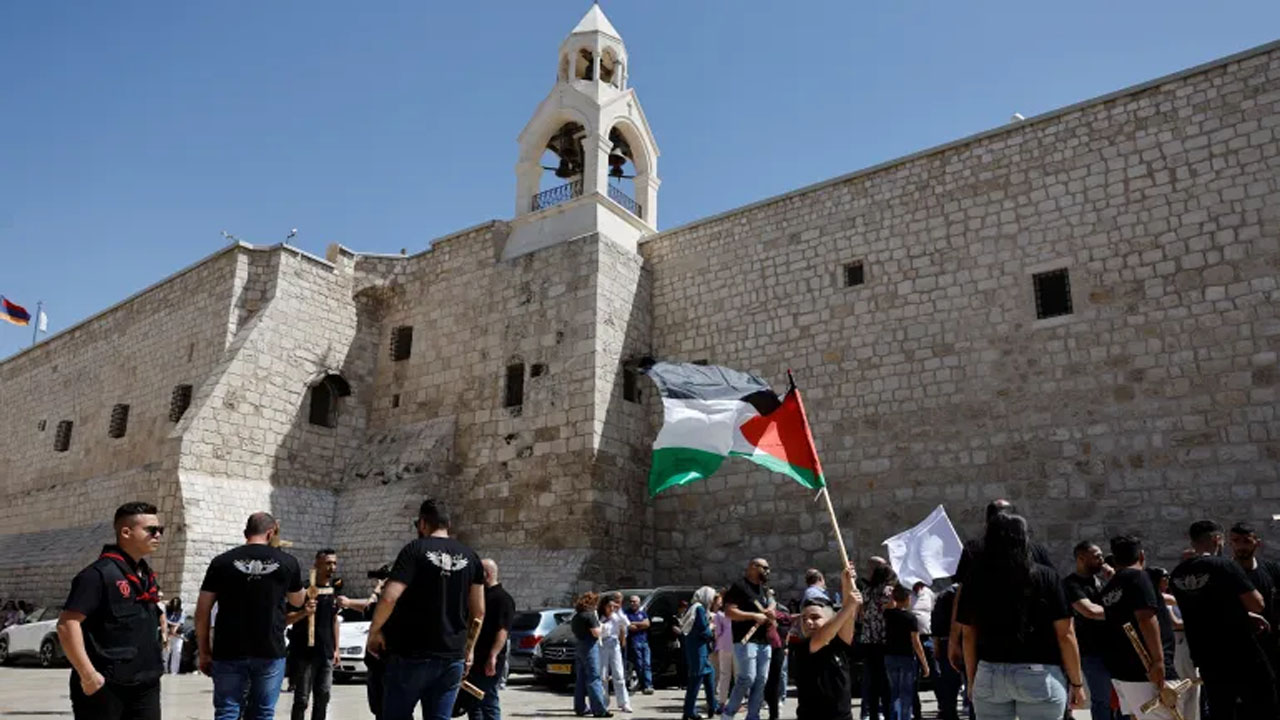
For Palestinian Christians, the cost of this theological distortion is far from theoretical. Israeli military operations in Gaza have killed Christians and bombed churches, leaving historic Christian communities displaced and grieving. Church leaders in the West Bank have also warned of increasing attacks by Israeli settlers. Meanwhile, the Rossing Center documented 155 incidents of violence against Christians and Christian property in the Holy Land during 2025.
That is why I increasingly hear evangelicals expressing discomfort with using Scripture to justify Israel's actions. They have not abandoned the Jewish people. They simply refuse to let their faith be used to sanctify policies that harm their neighbors.
They are unwilling to remain silent while the Church is being silenced in the very land where it was born.
The Bible's true command is not blind loyalty to any flag or army. It is to speak the truth, forgive, pursue peace, and love without partiality. Faithfulness to God must never be confused with granting immunity for human wrongdoing.
If Christians truly wish to bless the people of the Holy Land, they must oppose every form of injustice. And if they wish to bless the Church there, they must listen to it before it disappears altogether.
Author: Rev Dr Fares Abraham. A Palestinian-American pastor and social activist who has long worked to advance Palestinian rights and promote peace in the Middle East. He is the founder and president of Levant Ministries, a Florida-based nonprofit organization.