
.png)

Bangladesh, Pakistan hold Home Minister-level bilateral meeting
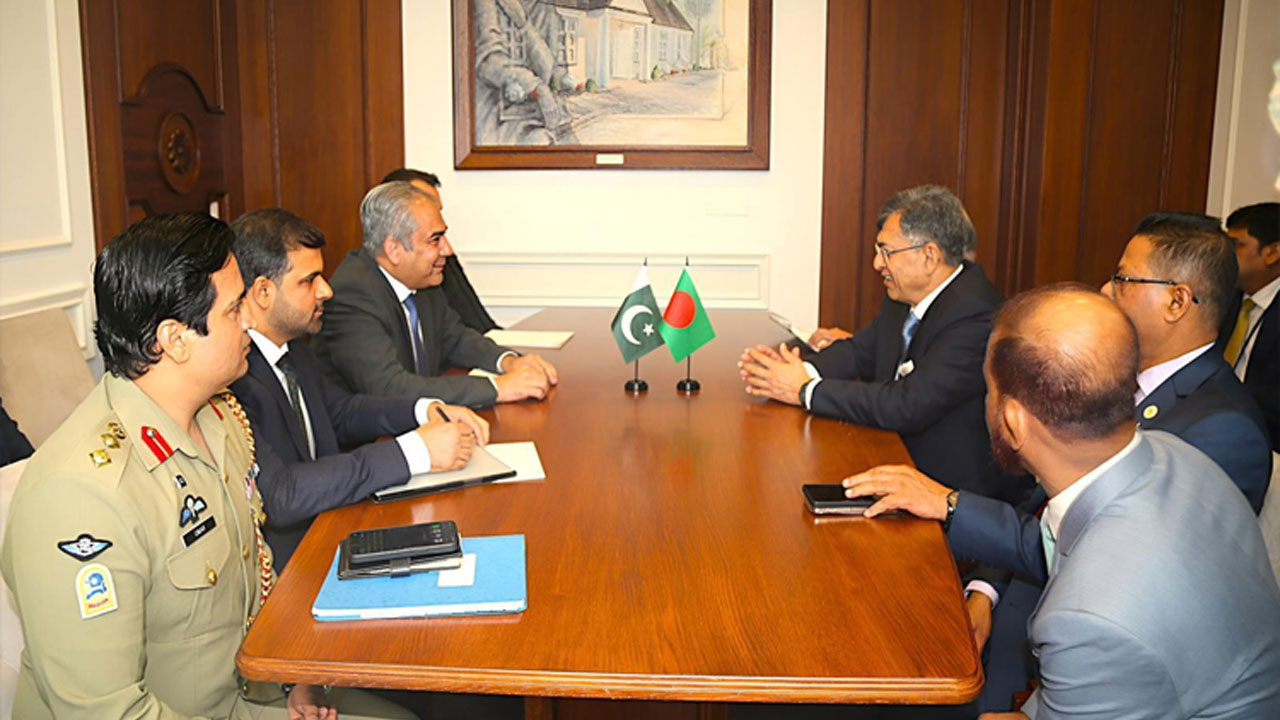
A high-level bilateral meeting between the home ministers of Bangladesh and Pakistan was held on Tuesday (July 7) at the United Nations Headquarters in New York, United States.
According to a press release issued by Bangladesh's Ministry of Home Affairs on Wednesday (July 8), the Bangladeshi delegation was led by Home Minister Salahuddin Ahmed, while the Pakistani delegation was headed by Syed Mohsin Naqvi, Pakistan's Minister for Interior and Narcotics Control.
The meeting focused on a range of issues of mutual interest, including bilateral security cooperation, regional stability, combating drug trafficking, modern urban security, enhancing police capacity, and the Rohingya crisis.
At the outset of the discussions, Home Minister Salahuddin Ahmed recalled the Pakistani home minister's visit to Bangladesh in May this year.
He said that, as a follow-up to that visit, the memorandum of understanding (MoU) signed between the two countries to prevent the illicit trafficking and abuse of narcotic drugs and psychotropic substances would play an effective role in strengthening border security and protecting society.
Referring to bilateral relations, the home minister said Bangladesh seeks to further strengthen its ties with Pakistan based on their shared history, mutual respect, understanding, and partnership.
He also noted that the resumption of Biman Bangladesh Airlines' direct flights between Dhaka and Karachi in January this year, after a 14-year suspension, has opened new opportunities for people-to-people contact as well as trade and commerce between the two countries.
During the meeting, the home minister highlighted the humanitarian challenges faced by people of Bangladeshi origin living in Pakistan.
He said that many Pakistani citizens of Bangladeshi origin and their family members are facing difficulties in obtaining Pakistan's Computerized National Identity Card (CNIC) due to the lack of required family documentation. As a result, they are being deprived of fundamental rights such as access to education and healthcare.
Expressing concern over the issue, he urged the Pakistani minister to consider it from a humanitarian perspective and work toward a swift and permanent solution.
Highlighting Pakistan's successful use of modern technology in urban security, the home minister said the country's Safe City initiative, implemented in more than 40 major cities, could serve as a model for Bangladesh.
He further noted that Bangladesh's then Senior Secretary of the Ministry of Home Affairs, now the Cabinet Secretary, visited the Safe City projects in Islamabad, Lahore, Multan, and Karachi in September 2025. Drawing on that experience, he said Pakistan could provide technical and strategic assistance to help make Bangladeshi cities safer.
The home minister also sought Pakistan's cooperation in providing advanced training to Bangladesh Police officers to further enhance the force's professionalism and operational capacity.
On the Rohingya crisis, he recalled that Bangladesh and Pakistan had previously worked together to address issues involving undocumented Rohingyas residing in Saudi Arabia. He said closer consultations and practical cooperation between the two countries could continue to play an effective role in addressing similar regional and global challenges.
He added that Bangladesh expects Pakistan's strong and continued support in international forums to ensure that Myanmar repatriates its displaced citizens in a safe, dignified, sustainable, and timely manner.
At the conclusion of the meeting, Pakistan's Interior Minister invited Home Minister Salahuddin Ahmed to visit Pakistan. In response, the Bangladeshi minister thanked him for the invitation and expressed his willingness to undertake the visit at a mutually convenient time.
Senior officials from the home ministries of both countries were also present at the meeting.