
Workshop held on challenges of Bangladeshi women migrant workers
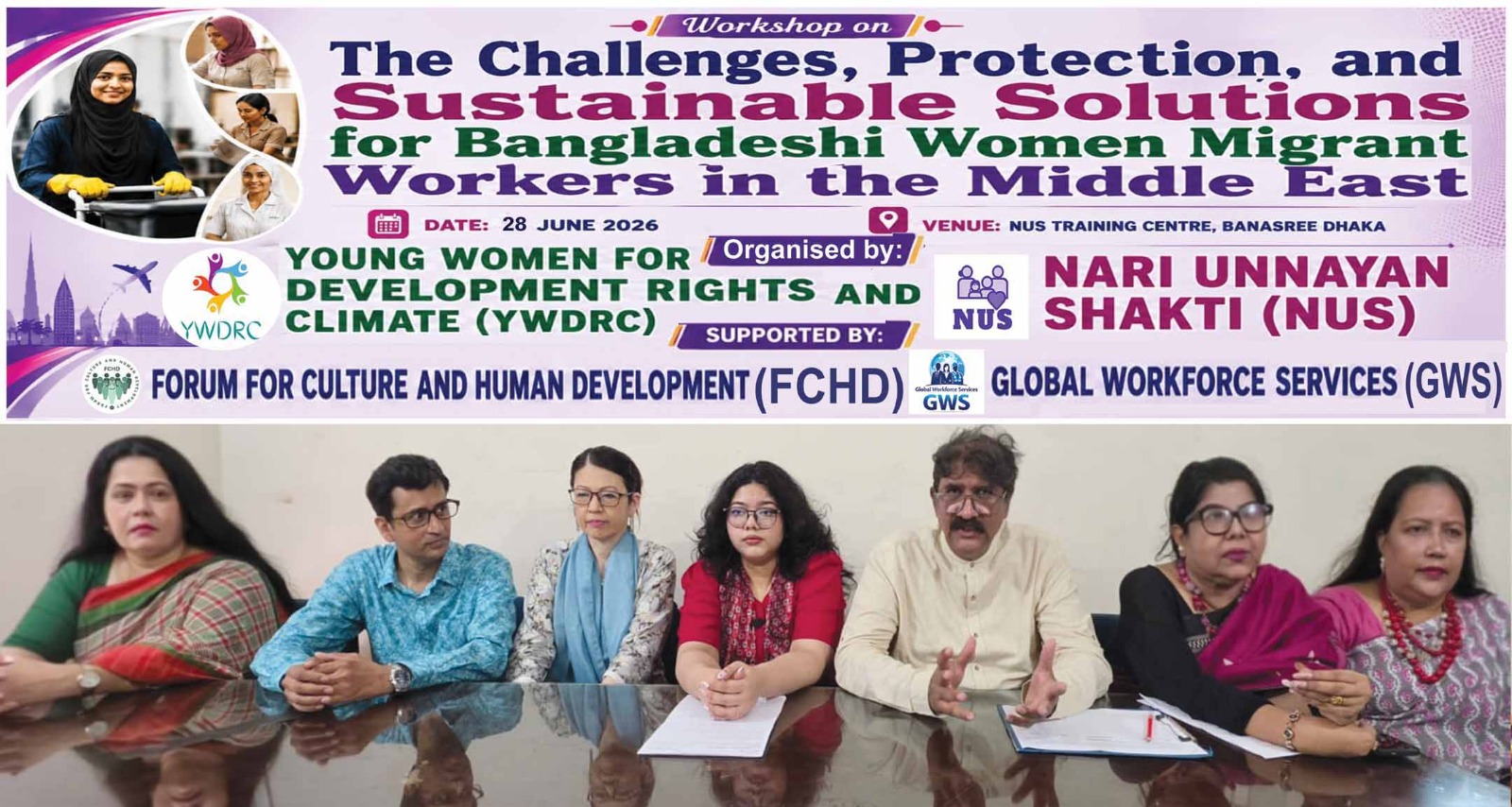
A workshop titled "Challenges, Protection, and Sustainable Solutions for Bangladeshi Women Migrant Workers in the Middle East" was held today at the Nari Unnayan Shakti (NUS) Training Centre in Banasree, Dhaka.
The workshop focused on the challenges faced by Bangladeshi women migrant workers employed in the Middle East, with particular emphasis on their safety, human rights, legal protection, and sustainable policy solutions. The event was jointly organized by Young Women for Development Rights and Climate (YWDRC) and Nari Unnayan Shakti (NUS), with support from Forum for Culture and Human Development and Global Workforce Services.
The Chief Guest of the workshop was Mr. Md. Riaz Uddin Khan, Chairman of the Bangladesh Migrants' Rights Forum. The session was chaired by Ms. Nusrat Sultana Afroz, Executive Chairperson of Young Women for Development Rights and Climate (YWDRC), while the keynote paper was presented by Dr. Afroja Parvin, Executive Director of Nari Unnayan Shakti (NUS).
In her keynote presentation, Dr. Afroja Parvin highlighted the lived experiences of Bangladeshi women migrant workers in the Middle East, outlining the risks they encounter, including workplace exploitation, violence, abuse, and the limitations of existing legal protection mechanisms.
She stressed that ensuring safe migration requires mandatory pre-departure training for all women migrant workers covering language proficiency, vocational skills, labour laws, human rights, self-defense techniques, HIV and AIDS prevention, sexual and reproductive health, mental health awareness, financial literacy, and emergency response procedures.
She further emphasized the need to establish an integrated protection system to ensure rapid rescue, legal assistance, medical care, safe shelter, and effective rehabilitation for women migrant workers who become victims of abuse abroad.
Addressing the workshop, Chief Guest Mr. Md. Riaz Uddin Khan called for a dedicated gender-responsive national budget to strengthen the protection and welfare of women migrant workers. He also urged the Government of Bangladesh to enhance labour diplomacy with destination countries in order to secure safe, dignified, and rights-based working conditions for Bangladeshi women migrants and to ensure timely and effective consular support whenever required.
In her presidential remarks, Ms. Nusrat Sultana Afroz said that safe migration is not merely an employment issue but fundamentally a matter of women's dignity, human rights, and social justice.
She emphasized that the voices, experiences, and recommendations of women migrant workers must be reflected in national policy formulation. She further called upon the Government, development partners, civil society organizations, the private sector, and the media to work collaboratively in building a humane, accountable, and sustainable migration governance system through adequate government budget allocations and effective partnerships with non-governmental organizations.
The workshop was also addressed by Ms. Mariko Adachi, a volunteer from Japan working with Nari Unnayan Shakti (NUS), Mr. Mohammad Yasin Patowary, Ms. Salina Akter, Executive Member of SHILEAD, and Ms. Riya Akter, Representative of the Bangladesh Domestic Workers Employers' Association. The speakers emphasized the importance of protecting the rights of women migrant workers through enhanced skills development, safe working environments, social recognition, and comprehensive reintegration support upon their return to Bangladesh.
The workshop adopted a number of important recommendations, urging the government to make comprehensive pre-departure training mandatory for all women migrant workers, establish 24-hour emergency response centres and safe shelters at every Bangladesh Embassy in Middle Eastern countries, ensure rapid rescue.
It also suggested for medical treatment, legal aid, and rehabilitation for victims of abuse, allocate a dedicated national budget for the protection of women migrant workers, take stringent action against illegal recruitment agents and human traffickers, implement comprehensive reintegration, employment, and entrepreneurship programmes for returning migrant workers, strengthen bilateral labour agreements with destination countries, and provide adequate government funding to implement these initiatives in partnership with experienced non-governmental organizations.
The workshop concluded with a strong expression of hope that the Government would take immediate and effective measures to safeguard the safety, dignity, and human rights of Bangladeshi women migrant workers and work together with all relevant stakeholders to establish a safe, orderly, rights-based, and humane migration system.