
AB party calls for unity against exploiters and looters
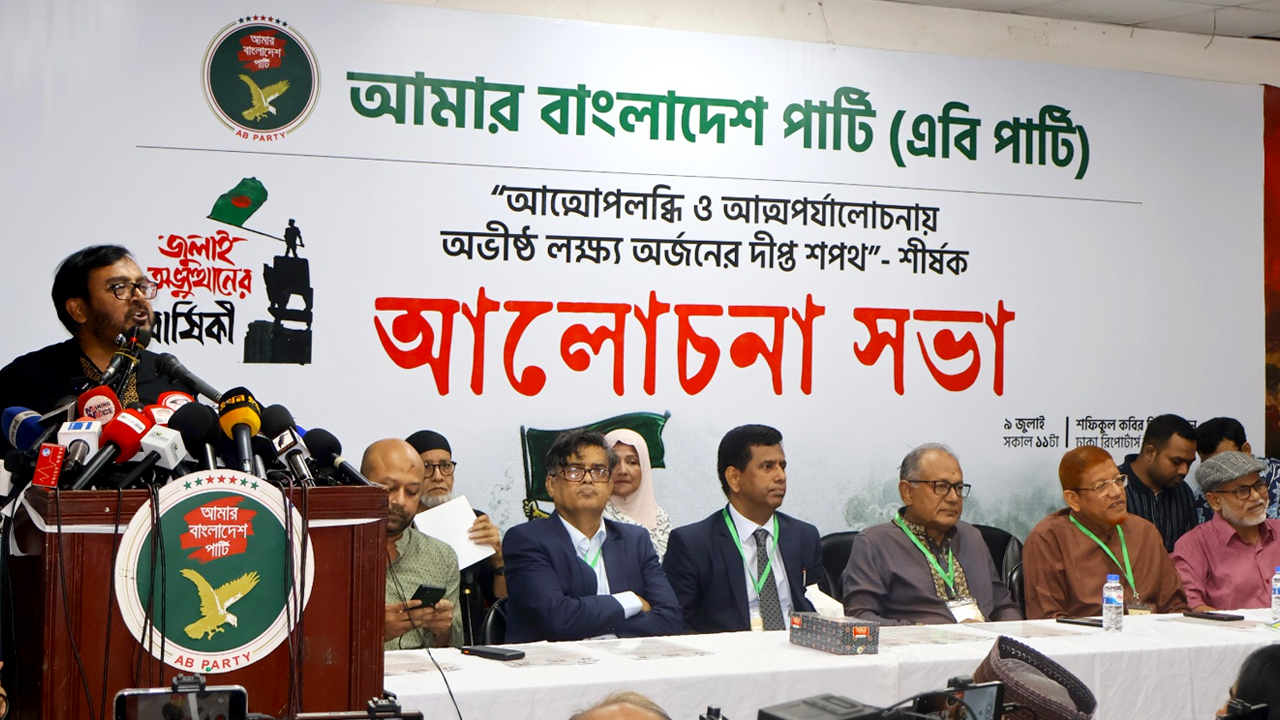
My Bangladesh Party (AB Party) has pledged to uphold the spirit of the July Mass Uprising and remain united in the struggle against those who, it says, exploited and looted the country before fleeing abroad.
The pledge was made by the party's leaders at a discussion marking the second anniversary of the July Mass Uprising, held on Thursday (July 9) at the Shafiqul Kabir Auditorium of the Dhaka Reporters Unity in the capital.
The event, themed "A Solemn Pledge Through Self-Realization and Self-Reflection to Achieve Our Desired Goals," was chaired by AB Party Chairman Mujibur Rahman Manju and moderated by Joint General Secretary Md. Altaf Hossain.
Among those who addressed the event were BNP Vice Chairman Dr. Asaduzzaman Ripon, Jamaat-e-Islami Assistant Secretary General Hamidur Rahman Azad, Nagorik Oikya President Mahmudur Rahman Manna, National Citizen Party (NCP) Member Secretary Akhtar Hossain, Rokeya Begum, mother of July martyr Jabir Ibrahim, former Press Secretary to the Chief Adviser Shafiqul Alam, former Chief Prosecutor of the International Crimes Tribunal Advocate Tajul Islam, and other political leaders and guests.
Speaking at the event, BNP Vice Chairman Dr. Asaduzzaman Ripon said there is no political reality for former Prime Minister Sheikh Hasina to return to Bangladesh, adding that no country in the world has shown interest in accepting her.
He said the occupation of Ganabhaban was an unprecedented event in history and reflected the people's complete loss of confidence in her government.
"The people of Bangladesh will never accept Sheikh Hasina again. However, everyone must remain vigilant. Changes in the state and politics do not happen overnight; they are established gradually, and Bangladesh is moving along that path," he said.
Dr. Ripon also alleged that during what he described as the "fascist regime," the Appellate Division had been used to obtain directives aimed at obstructing investigations into individuals involved in corruption and looting, which he claimed undermined the foundations of justice.
He stressed that those associated with what he termed fascism should never again be entrusted with state power or any form of authority.
Criticizing the Leader of the Opposition, he said allegations of manipulation in selecting the opposition leader were being used to weaken the democratic system.
"Political differences and disagreements may exist. But on the issues of the spirit of the July Mass Uprising, Bangladesh's independence, and national sovereignty, all democratic forces must remain united," he added.
Jamaat-e-Islami leader Hamidur Rahman Azad said July symbolizes the aspirations of the nation and victory against injustice and authoritarianism.
He claimed that although the people had expressed support for reforms through a referendum, that public mandate was being ignored.
He called for an end to impunity, implementation of fundamental reforms, and governance based on the people's will.
Nagorik Oikya President Mahmudur Rahman Manna said not a single reform outlined in the July Charter had yet been implemented.
He argued that without restructuring the state, it would not be possible to prevent the return of authoritarianism.
"People have not forgotten July. The commitments of July can only be fulfilled by continuing the struggle to establish genuine democracy," he said.
Rokeya Begum, mother of a July martyr, said the movement would not have succeeded without the courageous role played by journalists.
She said the sacrifices of the martyrs were made to establish a state based on justice and urged the authorities to stop delaying implementation of the July Charter.
NCP Member Secretary Akhtar Hossain said the quota reform movement transformed into a mass uprising through participation from people of all walks of life.
He said the country cannot be governed by ignoring the people's mandate and called for implementing the reform agenda endorsed by the public to dismantle what he described as an authoritarian state structure.
Former Press Secretary to the Chief Adviser Shafiqul Alam said the spirit of July must serve as the foundation for building the future of Bangladesh.
He called for ensuring justice for everyone involved in killings, enforced disappearances, secret detention facilities known as Aynaghar ("House of Mirrors"), and human rights violations.
"The pledge of July is that no one should be able to commit killings and escape justice," he said.
Former Chief Prosecutor of the International Crimes Tribunal Advocate Tajul Islam said the movement was not solely about elections but also about justice, reforms, and rebuilding the state.
He urged the government to turn previously repealed reform ordinances back into law, establish a July Museum, and ensure that the history of July is passed on to future generations.
AB Party Secretary General Barrister Asaduzzaman Fuad described July 2024 as the most powerful mass uprising in Bangladesh's history.
"It was not led by any political party; the country's youth led the movement. The achievements of July must be protected politically and constitutionally so that authoritarianism can never rise again," he said.
In his closing remarks, AB Party Chairman Mujibur Rahman Manju said the July Mass Uprising was not merely the fall of a government but a historic commitment to rebuilding the state, ensuring justice, and restoring the dignity of the people.
He expressed concern that, two years later, forces defeated by the July uprising were deliberately trying to undermine its legacy.
Referring to slogans used by supporters, Manju said, "They say, 'Don't keep talking about July, or you'll pay the price.' But we say, 'We will keep talking about July, we will embrace July until our last breath,' 'Sheikh Hasina will not return, and the people of the country will not rejoice,' and 'Sheikh Hasina will face justice, and Bangladesh will smile.'"