


A quiet man in a loud republic
A few days before Bangladesh’s general election of December, 2018, the opposition alliance led by the Bangladesh Nationalist Party released a campaign video. Mirza Fakhrul Islam Alamgir, the BNP’s secretary general, appeared before the camera asking the countrymen to vote to restore democracy.

The election would later acquire the derisive name “midnight election,” after allegations that ballot boxes had been stuffed before polling stations opened. On that video Mirza Fakhrul, as hopeful as he was, asked Bangladeshis to go to the polling booth.
He spoke about democracy, about the importance of exercising voting power, about fear of seeing the country’s dictatorial turn under Sheikh Hasina, and then about 1971. He recalled fighting the “Punjabi soldier” during the Liberation War and said that he wanted, once again, to fight…this time to restore democracy from the authoritarian clasp of Hasina.
For a surprisingly large number of Bangladeshis, the striking part was the biographical disclosure. Mirza Fakhrul was a freedom fighter.
This was partly an accident of Bangladesh’s peculiar ownership dispute over its history. During its long rule, the Awami League had made the Liberation War an instrument of partisan legitimacy. Political opponents could find themselves written out of 1971 or placed on its wrong side.
Even Ziaur Rahman, the decorated sector commander who later founded the BNP, was subjected to sustained attempts to diminish his wartime role. That Fakhrul’s own participation in the war remained comparatively little known was therefore not entirely surprising.
But it also said something about Mirza Fakhrul. In a political culture in which historical credentials are displayed like medals, he had been curiously uninterested in displaying his own. Bangladesh has no shortage of politicians who have turned an afternoon at a demonstration into a lifetime revolutionary resume.
Fakhrul, who had actually lived through the mass uprising of 1969 and participated in the Liberation War, rarely made himself an important character of either.
Only much later did he describe the war in detail in several interviews. He recalled organizing resistance in Thakurgaon, obtaining weapons from a police arsenal, helping dismantle a bridge to impede Pakistani troops, establishing a control room and makeshift weapons training, and eventually crossing the Nagar River into India after Pakistani forces overwhelmed local resistance.
In West Bengal, he helped organize young recruits for training camps, including one run with assistance from India’s Border Security Force.
There is something almost inconvenient about this biography because it resists the tidy categories of Bangladeshi politics. Mirza Fakhrul was a freedom fighter, yet never used a megaphone to say so. He came from the left, but eventually joined the BNP. He is a Bengali cultural Tagore-loving liberal inside a nationalist party often lazily described as uniformly conservative.
He has spent much of his career accused by one side of being insufficiently ‘patriotic’ and by another of being insufficiently ‘Islamic.’
The quite yet defiant one
On Thursday, another role was prepared for him. Prime Minister Tarique Rahman formally announced Mirza Fakhrul as the BNP’s candidate for President of Bangladesh.
Given the BNP’s two-third parliamentary majority, the election is expected to be largely procedural. Barring a political surprise, the seventy-eight-year-old Fakhrul will become the country’s twenty-third President.
It is a strangely suitable destination for a politician whose most identifiable quality has been temperament.
Even Obaidul Quader, the Awami League general secretary and for years Fakhrul’s opposite number, once conceded this. In 2019, after an election in which the two parties had accused each other of almost every conceivable political sin, Quader called Fakhrul “a gentleman” and “a good man.”
More revealingly, he said that he had never heard Fakhrul use abusive language.
This was not a trivial distinction. Bangladeshi political speech during the Hasina years became unusually coarse. Senior Awami League figures routinely subjected opposition leaders to personal ridicule. Fakhrul, as the BNP’s principal public voice during Khaleda Zia’s imprisonment and Tarique Rahman’s exile, absorbed an extraordinary amount of it.
His usual response was the same faintly weary expression…followed by another press conference.
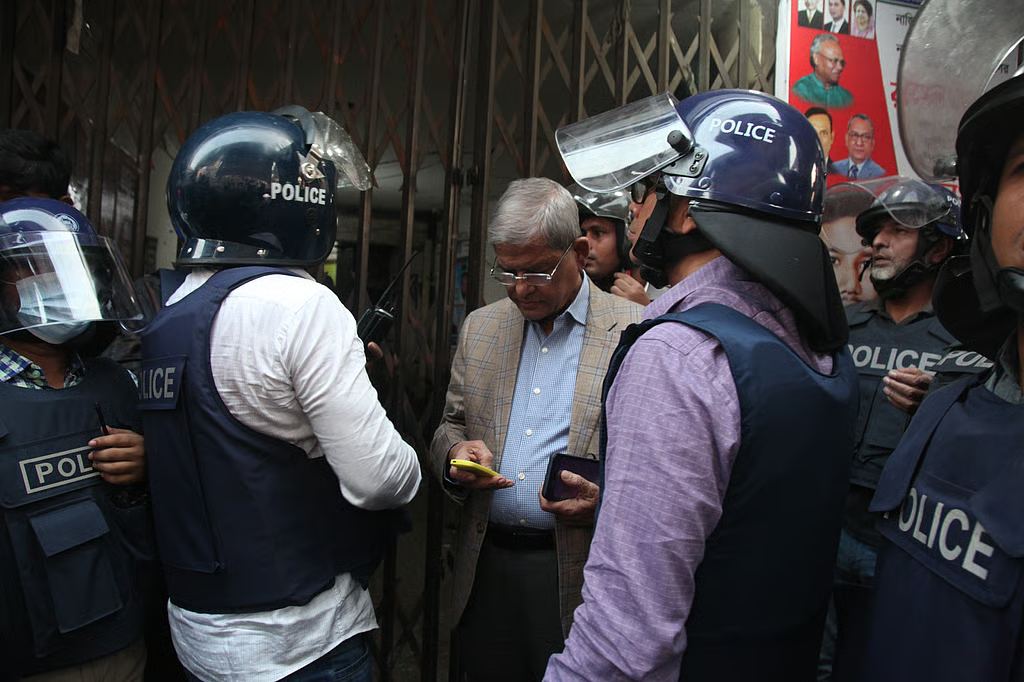
His mildness could sometimes seem almost comic against the violence surrounding him. Police raided BNP offices, activists disappeared, rallies ended in tear gas and arrests, and Fakhrul kept appearing at the party’s Naya Paltan headquarters: white panjabi or white shirts, glasses, brushed salt and pepper hair.
There are political careers constructed from grand gestures. Fakhrul’s was constructed, to an unusual degree, from showing up. Quietly and decisively.
The cost was not metaphorical. After the BNP’s October 28, 2023, rally in Dhaka descended into violence, police detained him at his home. Within hours, the number of cases against him had reportedly reached one hundred. He was sent to jail while many other opposition leaders went underground.
The broader crackdown before the January, 2024, election swept up thousands of BNP activists; Mirza Fakhrul remained incarcerated as the party prepared to boycott the vote.
One episode seems to have wounded him more than most. In December, 2022, his wife, Rahat Ara Begum, was preparing for surgery after being diagnosed with a serious illness. Police arrived at Fakhrul’s house at around three in the morning and took him away. “While my wife was having her surgery, I was in jail,” he later wrote. His daughter rushed to Dhaka; Fakhrul could do little except receive news from prison.
He did not turn the episode into a political identity. That, too, is characteristic. Fakhrul has spent years speaking in the plural—our party, our people, our country—in a profession largely populated by practitioners of the first-person singular.
A political legacy
He was born in Thakurgaon in 1948 into a family for whom politics was already something of a hereditary occupation.
His father, Mirza Ruhul Amin, was a lawyer and politician who served in Parliament; his uncle Mirza Golam Hafiz became Speaker of Parliament and later a cabinet minister. Another uncle, Wing Commander SR Mirza, served the wartime Mujibnagar government and oversaw youth camps training recruits for the Liberation War.
His father’s record has itself become a political controversy. Awami League figures and others have accused Ruhul Amin, who had Muslim League roots, of involvement with a Peace Committee during 1971. Mirza Fakhrul has rejected the portrayal, saying his father spent almost the entire war in India.
The dispute is typical of Bangladesh, where the dead are routinely conscripted into contemporary political battles.
The younger Mirza’s own early politics were considerably to the left of the BNP. At Dhaka University, where he studied economics, he joined the East Pakistan Students Union, associated with the Communist movement, and rose to become president of its university unit during the 1969 mass uprising against Ayub Khan.
After independence, he taught economics at Dhaka College, worked in government service, and served as secretary to Deputy Prime Minister SA Bari during Ziaur Rahman’s presidency, and later returned to teaching at Thakurgaon Government College.
He resigned from government service before entering local electoral politics—an act that now seems almost quaint. He won the chairmanship of Thakurgaon municipality as an independent in 1988 and joined the BNP around the time of the anti-Ershad movement. By 1992, he was leading the party in Thakurgaon.
He won a parliamentary seat in 2001 and served first as state minister for agriculture and later for civil aviation and tourism.
His national ascent came after the BNP lost power. He became senior joint secretary general in 2009 and acting secretary general in 2011, following the death of Khandaker Delwar Hossain. Five years later, the title became permanent.
It meant that the most important period of his leadership coincided with the distribution of arrest warrants rather than the distribution of ministries.
Mirza Fakhrul has described himself as a liberal democrat. “I used to engage in leftist revolutionary politics,” he told The Daily Star newspaper in 2024, explaining that experience had persuaded him that progress could come only through democracy. The old leftist has never entirely disappeared though.
His cultural instincts, penchant for universal humanity, a slight suspicion of religious politics and emphasis on pluralism have sometimes made conservatives within the broader anti-Awami League constituency uneasy.
Ideology and reservation
This is where the designation “gentleman” can obscure as much as it reveals.
Fakhrul is courteous, but he is not politically neutral. He has ideological dislikes, and in the more competitive politics that followed Hasina’s fall, some of them became more visible.
His exchanges with Jamaat-e-Islami were particularly revealing. Fakhrul repeatedly emphasized 1971 at a time when some younger political constituencies appeared eager to downgrade the war’s importance after the July uprising.
In March, 2025, he complained that people who had “assisted the Pakistani killing campaign were again speaking loudly,” and warned against pretending that 1971 had somehow ceased to matter. His unease at the rise of right-wing politics prompted some critics to dismiss him as an old leftist seeing reactionaries everywhere.
Yet Fakhrul has also been pragmatic enough to understand the country he inhabits. During the 2026 campaign, he told Al Jazeera that “secularism” was not the BNP’s objective and that the word itself was not congenial to Bangladeshi politics; he preferred to speak of equal rights for all religions.
It was a careful formulation from a politician whose instincts are plainly more socially liberal than those of many voters in his party.
The carefulness occasionally deserts him. In Rangpur this month, Fakhrul suggested that the region remained behind because its voters had repeatedly backed parties other than the BNP—first the Jatiya Party and then Jamaat—and asked how they could expect development.
Jamaat MPs protested, and the party organized a procession in Rangpur demanding that he withdraw the remark. The criticism was justified…suggesting that development should follow partisan voting is an unattractive argument for any minister, especially one preparing to become a constitutional head of state.
There have been other moments during the bitter BNP-Jamaat competition when the patient ‘former teacher’ has sounded more like an election candidate. Power has introduced a difficulty that opposition did not. It is easier to speak serenely about democratic fairness when the police are arresting you than when your own party controls the government.
His critics on the nationalist right have another complaint: India. In the fevered taxonomy of Bangladeshi politics, Fakhrul’s preference for a functional relationship with New Delhi has periodically been enough to invite accusations that he is soft on India, even a “RAW agent.”
Such accusations coexist awkwardly with his record. During the Liberation War, Fakhrul has recalled being viewed suspiciously by Indian authorities precisely because he belonged to the left outside the Awami League orbit; he said activists like him faced restrictions even while organizing the war effort.
He has tended to answer these charges without adopting the theatrical anti-Indianism that is often politically profitable in Bangladesh. This, perhaps more than any policy position, marks his political personality…Mirza Fakhrul rarely appears desperate to win an argument in the room.
The ‘gentleman’ becomes the President
In January, campaigning in his native Thakurgaon, he told voters that his family had sold ancestral land to sustain its politics rather than becoming rich from it. “I will not betray the trust you place in me,” he said.
Such declarations normally deserve journalistic suspicion. But Fakhrul’s public career has an unusual absence of the financial mythology that surrounds many senior Bangladeshi politicians. His reputation, including among opponents, has rested less on claims of personal austerity than on the lack of persuasive evidence contradicting them.
Now the long-serving party functionary is being moved out of party politics. The presidency in Bangladesh is constitutionally constrained, and Fakhrul’s nomination also solves a practical problem for Tarique Rahman: it provides an honourable culmination for a secretary general who carried the BNP through its bleakest years while making room for a new generation in the party hierarchy.
But it may also suit Mirza Fakhrul himself.
The Presidency demands precisely the quality for which he has sometimes been mocked…restraint. Bangladesh has recently had an abundance of revolutions, counter-revolutions, declarations, anniversaries and competing claims to historical ownership. Every political generation seems determined to establish that history began when it arrived.
Fakhrul belongs to several histories without quite claiming any of them for himself. He was in the streets in 1969. He organized resistance in 1971. He entered electoral politics during the struggle against Ershad. He spent the Hasina years travelling between rallies, party offices, courtrooms and jail cells.
And, when the regime that had imprisoned him finally disappeared, he returned as a minister, still speaking in the measured cadence of the economics teacher he once was.
The campaign video from 2018 looks different now. The elderly politician asking Bangladeshis to remember democracy was talking about a war he had rarely advertised fighting. In a country where the Liberation War was for years treated as partisan property, and where every subsequent uprising has produced new arguments over who owns the revolution, there is something refreshing about a politician who possessed a genuine claim to history and somehow neglected to market it.
Bangladesh has produced more charismatic politicians than Mirza Fakhrul Islam Alamgir, more commanding ones, more quotable ones and certainly louder ones. What it has produced rather less frequently is a senior politician capable of surviving decades in public life without making vulgarity part of his political vocabulary.
The “gentleman of Bangladeshi politics” is now likely to become its President. The interesting thing is that, after nearly half a century in politics, the title still does not sound entirely ironic.