


23pc of Bangladeshi girls become mothers between ages of 15 and 19
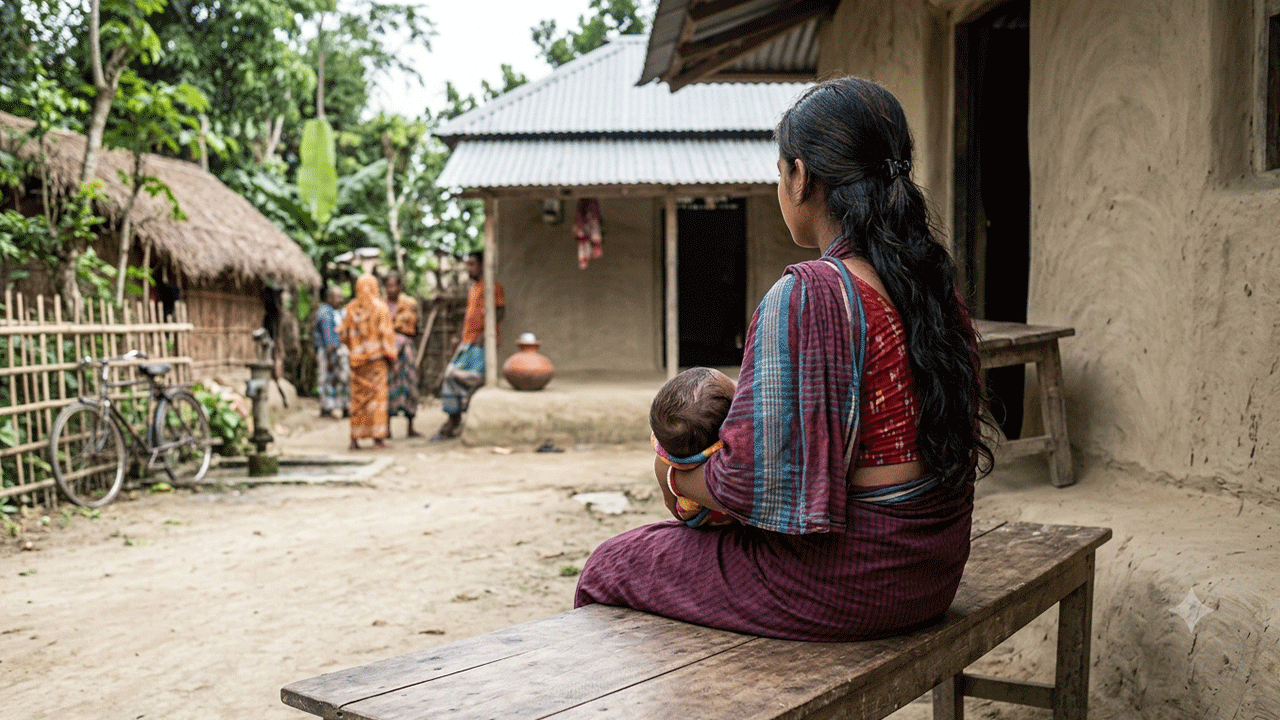
About 23.2percent of girls aged 15 to 19 in Bangladesh have already become mothers, with 1.2percent giving birth before the age of 15, according to a new report.

The findings were published in the Multiple Indicator Cluster Survey (MICS) 2025, jointly conducted by the Bangladesh Bureau of Statistics (BBS) and UNICEF.
According to the report, the country is witnessing a renewed rise in adolescent motherhood due to limited progress in preventing child marriage, inadequate access to reproductive health services, and various social factors.
Within just five years, the adolescent birth rate has reached a record high. Experts warn that pregnancies at such an early age increase the risks of stillbirth, premature birth, maternal and child malnutrition, and overall health complications and mortality.
Reproductive health specialists say adolescent motherhood is not merely a public health issue—it is closely linked to education, poverty, gender inequality, and social norms. They stress that raising awareness among parents about the harmful consequences of child marriage, educating communities on the risks of teenage pregnancy, and implementing targeted family planning programmes are essential to sustainably reduce the trend.
Urban Areas Also See Record Increase
The adolescent birth rate measures the number of live births per 1,000 girls aged 15 to 19 in a year.
According to the report, the rate increased from 83 births per 1,000 adolescent girls in 2019 to 92 per 1,000 in 2025.
Urban areas, which traditionally recorded lower rates, also experienced a significant increase—from 70 to 80 births per 1,000 girls over the five-year period. In rural areas, the rate rose from 87 to 97 per 1,000.
Prof. Mohammad Mainul Islam, Dean of the Faculty of Social Sciences and Professor of Population Sciences at the University of Dhaka, told Asia Post that the high prevalence of child marriage is driving the increase in adolescent motherhood.
"Marriage at an early age remains widespread in Bangladesh, and there is a strong social expectation that couples should have children within one or two years of marriage. As a result, newly married adolescent couples are less likely to adopt family planning methods. The government's programmes have not reached the desired level of effectiveness, leading to rising adolescent motherhood even in urban areas," he said.
Rajshahi Records the Highest Rate, Sylhet the Lowest
The divisional analysis shows that Rajshahi has the highest proportion of girls giving birth before the age of 18, at 29pc, followed by Rangpur (28pc) and Khulna (27pc).
In terms of adolescent births per 1,000 girls, Rangpur recorded the highest rate at 111, while Sylhet had the lowest at 50.
The adolescent birth rate stands at 61 per 1,000 among girls from wealthier households, compared with 120 per 1,000 among those from low-income families.
The country's total fertility rate (TFR) has also increased—from 2.3 in 2019 to 2.4 in 2025. Fertility is highest in Mymensingh (2.8) and Chattogram (2.7) divisions.
Child Marriage Remains the Main Driver
The report identifies child marriage as the leading cause of adolescent motherhood.
The proportion of girls married before the age of 18 declined from 60% in 2019 to 56%, but the pace of reduction remains slow.
Limited access to contraceptive methods and a lack of decision-making power within families also contribute significantly to adolescent pregnancies.
According to the Bangladesh Demographic and Health Survey (BDHS) 2022, nearly 46% of girls aged 15 to 19 are not using any form of contraception. Moreover, 13% are unable to access contraceptives despite wanting them because of social stigma or lack of availability.
Md. Monjur Hossain, Programme Manager at the Directorate General of Family Planning, told Asia Post that the high rate of child marriage continues to fuel adolescent motherhood.
"Many parents remain unaware of the harmful consequences of child marriage. Although primary school enrolment has improved, secondary and higher secondary education rates remain low. Most parents who marry off their children at an early age have limited education and believe that marrying daughters off young requires a smaller dowry," he said.
He added that rapid urbanisation has also contributed to the problem.
"Nearly half of Bangladesh's population now lives in urban areas, many of them displaced by natural disasters and residing in slums. Families often live together in extremely cramped conditions, where newly married couples lack privacy, social protection, and security. These circumstances make it difficult to improve the situation," he said.
Monjur Hossain also highlighted legal loopholes.
"Although the legal minimum marriage age is 18 for girls and 21 for boys, many underage marriages are never officially registered. Registration often occurs only after the bride reaches 18 or 19, even though the couple has already been living together. In slum areas, this practice is almost universal."
He further said that one major weakness in the law is the provision allowing marriage below the legal age under "special circumstances."
"Parents frequently misuse this exception to arrange child marriages. Religious institutions could play a key role in addressing the issue. If mosque imams actively raise awareness among communities, the situation could improve considerably," he said.
Serious Health Risks for Mothers and Babies
According to the World Health Organization (WHO), girls aged 15 to 19 face a much higher risk of complications such as eclampsia and postpartum uterine infections than women aged 20 to 24.
Their babies are also more likely to be born prematurely or with low birth weight.
A study published in the Journal of Global Health in March found that 4% of 15,529 deliveries across eight district hospitals in Bangladesh resulted in stillbirths.
Doctors say one of the leading causes of stillbirth is the mother's young age, combined with inadequate antenatal care.
Prof. Dr. Anjuman Ara Rita, Head of the Gynaecology Department at Ashulia Women and Children's Hospital, told Asia Post that adolescent mothers face severe nutritional and medical challenges.
"Many pregnant women fail to receive adequate nutrition, making malnutrition a major concern during pregnancy. Among adolescent mothers, the situation is even more severe. They are also far more likely to suffer from anaemia, pre-eclampsia, and urinary tract infections," she said.
"Poor maternal nutrition restricts fetal growth, resulting in low fetal development. Since adolescent mothers are not physically mature enough for childbirth, they face higher risks of prolonged and obstructed labour, excessive bleeding during delivery, maternal death, and Caesarean section. Anaemia also commonly persists after childbirth," she added.
The Way Forward
Asked about possible solutions, Prof. Mohammad Mainul Islam said the government's family planning programme still has significant gaps.
"What Bangladesh now needs is a targeted family planning strategy. The national strategy adopted in 2025 must be implemented effectively. The allocated budget should be used to strengthen field-level programmes. There has been a longstanding shortage of personnel, and filling these vacancies would substantially improve the situation. At the same time, public awareness campaigns must be intensified," he said.