


Ashraf Textile embezzles Tk920 million from investors and workers
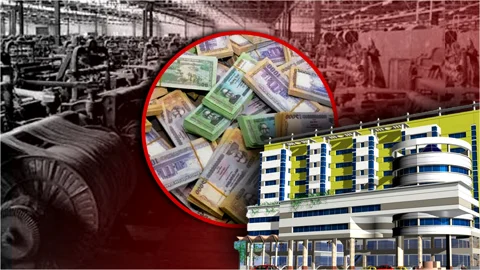
Evidence has emerged that Ashraf Textile Mills Limited of Tongi, Gazipur, allegedly misappropriated at least Tk920 million (92 crore) belonging to investors and the company's employees.

A special investigation by the Bangladesh Securities and Exchange Commission (BSEC), along with a follow-up investigation by Asia Post, has uncovered details of the alleged fraud.
The investigation found that the company cannot account for Tk720 million (72 crore) earned from the sale of land and commercial property. In addition, at least Tk200 million (20 crore) from workers' provident fund and gratuity payments was allegedly embezzled.
Although the company has been delisted from the stock market, 60.83% of its shares are owned by small investors. Without informing these shareholders, the company allegedly sold 42 bighas of land in Tongi along with a 7-bigha commercial complex.
The investigation identifies Managing Director Mahmud Ali Mridha and his syndicate as the principal architects of the alleged fraud. In May this year, BSEC sent letters to the Anti-Corruption Commission (ACC) and the Bangladesh Financial Intelligence Unit (BFIU) seeking legal action against those involved.
Speaking to Asia Post on condition of anonymity, a BSEC Deputy Director said:
"The investigation found irrefutable evidence of money laundering and fraud. We have therefore requested the ACC and the BFIU to take the necessary legal action."
The investigation further revealed that after the factory was illegally declared laid off in March 2006, Mahmud Ali Mridha's family syndicate allegedly began a systematic plan to seize the company's assets. A large portion of the money received from buyers was reportedly never deposited into the company's official bank accounts and instead disappeared.
The directors are accused of dividing among themselves the capital invested by ordinary shareholders as well as thousands of workers' unpaid gratuity and provident fund contributions. There are also allegations that family members laundered part of the money to Australia and Canada, where they are now enjoying the proceeds.
Investors' Money Vanished, Factory Shut Down
Ashraf Textile Mills Limited was established in 1962 on 16.69 acres of land in the Tongi industrial area of Gazipur. The mill operated 12,400 spindles and produced approximately 420 pounds of quality yarn per day.
When the company was listed on the stock market in March 1983, 60.83% of its shares were offered to public and institutional investors, while the remaining 39.17% were held by Mahmud Ali Mridha and the board of directors.
According to the BSEC investigation, after the 1984 initial public offering (IPO), ownership was evenly divided between public investors and the directors, with each holding 50%. However, by 2013, the directors' stake had fallen to just 25.15%, indicating they had secretly sold 24.85% of their shares.
BSEC concluded that these transactions violated multiple provisions of the Securities and Exchange Ordinance, 1969, and classified them as fraudulent.
Through the IPO in 1984, the company raised Tk38.6 million (Tk3.86 crore) from public investors. However, burdened with outdated machinery and bank loans, production ceased in March 2006. The company was subsequently delisted from the Dhaka Stock Exchange on October 4, 2009.
Factory Allegedly Carved Up Through Fraudulent Decisions
After being delisted, the company allegedly turned its annual general meetings (AGMs) into a vehicle for fraud. According to the BSEC investigation, after reporting losses for years, the management suddenly convened what investigators described as a staged AGM.
The investigation states that Mahmud Ali Mridha told general shareholders:
"The factory has become unprofitable because of its obsolete machinery. If we sell part of the abandoned land and use the proceeds to build a modern multi-storey commercial shopping complex (Ashraf Setu Shopping Complex) on the remaining land in Tongi, ordinary shareholders will receive substantial dividends, and the value of their shares will increase many times over. No additional investment will be required from shareholders."
Ashraf Textile’s Commercial Assets and Alleged Financial Irregularities
Ashraf Textile later signed an agreement with Setu Corporation to develop a commercial market beside the Dhaka–Tongi Highway. During several visits to the site, this reporter found that the project consists of a three-storey commercial building with a two-level basement. The complex now houses 1,157 wholesale and retail clothing shops, a garment factory, Setu Corporation's office, and the office of the Diabetic Association.
Under the agreement, Ashraf Textile was entitled to own 20 percent of the market's commercial space. However, the company no longer retains any ownership in the project. Its office now operates from a rented room of only 350 square feet, furnished with worn-out furniture.
Commercial Space Sold Below Market Value
On July 30, 2009, Managing Director Mahmud Ali Mridha recorded the sale of 66,818 square feet of commercial space to Setu Corporation at just Tk1,272 per square foot, valuing the transaction at Tk85 million (Tk8.5 crore).
However, an Asia Post investigation found otherwise. At the same time, individual shops measuring 15 feet by 10 feet (150 square feet) were being sold for more than Tk300,000 each, implying a market price of over Tk2,000 per square foot.
Mridha failed to provide a clear explanation for why the commercial space worth Tk85 million was sold at prices significantly below the prevailing market rate.
Land Worth Tk1.5 Billion Sold for Tk850 Million
Between 2009 and 2013, Ashraf Textile sold 42.22 bighas of land to Karnaphuli Industries for only Tk850 million (Tk85 crore) through a series of transactions.
According to company records, Tk690 million of the proceeds was used to repay bank loans, electricity bills, and debts owed to various companies. However, Managing Director Mahmud Ali Mridha could not account for the remaining Tk151.2 million.
A special investigation by the Bangladesh Securities and Exchange Commission (BSEC) found that, based on the government's minimum mouza valuation, the land was worth Tk1.3654 billion (Tk136.54 crore). This means it was transferred at Tk515.4 million below even the government's minimum assessed value.
Asia Post's investigation uncovered even more striking information. In 2009, the government's official mouza valuation in the area was Tk979,997 per decimal.
Local residents told Asia Post that the actual market price in 2010 ranged between Tk1.4 million and Tk1.7 million per decimal. Based on those rates, the land's true market value exceeded Tk1.5 billion (Tk150 crore), suggesting that the amount allegedly misappropriated or lost through fraudulent transactions was substantially higher than what was identified in the BSEC investigation.
Overall, BSEC investigators were unable to trace or verify Tk720.1 million (Tk72.01 crore) from land and commercial space transactions. This includes discrepancies of Tk515.4 million in land sale deeds, Tk152 million in unaccounted expenditures, and Tk53.5 million related to commercial space sales.
Workers' Tk200 Million Also Allegedly Missing
The BSEC special investigation committee also found evidence of alleged fraud involving provident fund and gratuity payments to workers.
In a written submission to the commission, Managing Director Mahmud Ali Mridha claimed that the company had paid Tk140 million to clear workers' outstanding dues, including Tk87.6 million received from Karnaphuli Industries and Tk53.5 million from Setu Corporation.
However, Asia Post's investigation found that the company's 2004-05 annual report showed total liabilities for employee leave and gratuity of only Tk5.6 million. After the factory closed, this figure rose to Tk28.6 million in the 2006-07 fiscal year.
Ashraf Textile has not conducted any external audit since 2014. According to the BSEC report, none of the company's audited financial statements ever showed employee liabilities exceeding Tk26 million.
Mohammad Ibrahim, who runs a roadside tea stall at Cherag Ali intersection in Tongi, told Asia Post that his father, Abdul Jalil Mir, had worked at Ashraf Textile. Unable to receive his regular salary, Abdul Jalil eventually resigned but never received his retirement benefits. Ibrahim said his father later died without proper medical treatment because of financial hardship.
The company's 2014 audit report claimed that Tk47.9 million had been paid for workers' leave and gratuity benefits, while another Tk45 million had been disbursed through the provident fund. However, the company failed to produce any supporting documents or banking records to substantiate those payments.
Asia Post's investigation indicates that Mahmud Ali Mridha and members of the board of directors allegedly misappropriated at least Tk200 million owed to employees.
Mridha Denies the Allegations
Responding to the allegations, Mahmud Ali Mridha told Asia Post:
"At that time, we were heavily burdened with debt. Had we failed to make repayments, the Industrial Loan Organization would have sold our assets to recover its money. As a result, we could not sell the properties at better prices. Banks were not yet fully online then, so it was not possible to preserve documentation for every payment made to workers."
"With permission from the High Court, we continued the company's business operations until 2023. We have also maintained regular communication with our shareholders. We did not commit any irregularities."