
One police personnel for every 6,500 residents in Mohammadpur
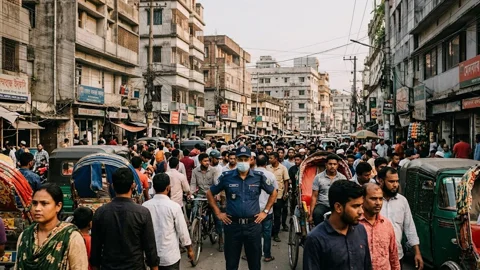
Mohammadpur has emerged as one of the crime epicenters of the capital. It is more densely populated than many district towns. While official records put the population at around 700,000, the actual number—including undocumented residents—is estimated at nearly 2 million. Yet only 310 police personnel are assigned to the police station responsible for this vast population. This means there is just one police officer for every 6,452 residents.
According to the United Nations standard, there should be at least 222 police officers per 100,000 people. In Mohammadpur, however, the ratio is only about 16 officers per 100,000 people, significantly lower than both the UN benchmark and the ratios seen in neighboring South Asian countries.
Moreover, not all 310 officers are on active duty at any given time. Around 20–25 percent are absent daily due to leave, court appearances, or other assignments, reducing the number of officers available for policing even further.
An analysis of internal police documents and duty rosters shows that of the 310 personnel:
• 160 are stationed at the police station,
• 55 are deployed at two police outposts, and
• 95 are assigned to temporary special camps.
The station has 42 Sub-Inspectors (SIs), but only a handful are available for patrol and crime prevention because most are occupied with investigations and administrative duties.
Many officers also spend their time responding to 999 emergency calls, escorting suspects to court, appearing as witnesses, providing victim support, performing hospital duties, and handling administrative work. As a result, responding quickly to crimes has become increasingly difficult.
Police officials have acknowledged the manpower shortage in conversations with journalists. They say that policing an area with nearly 2 million residents is extremely challenging with such limited personnel.
More Than 50 Crime Hotspots, Only 11 Patrol Teams
According to internal assessments by law enforcement agencies, Mohammadpur has more than 50 crime-prone hotspots. Residents, government officials, a director general of the Anti-Corruption Commission (ACC), and even police officers have repeatedly fallen victim to criminal attacks in the area.
To reach any emergency scene within 20 minutes, the police station would require at least 50 operational patrol teams. In reality, only 11 patrol teams are available.
Mohammadpur's geography provides criminals with a significant advantage. The area consists of densely populated residential neighborhoods on one side and the extensive embankments along the Buriganga and Turag rivers on the other. After committing robberies or muggings, criminals can quickly escape via the Bosila embankment toward Savar, Hemayetpur, or Gabtoli.
The area also includes the country's densely populated Geneva Camp (Bihari Camp), which has become a hub for drug trafficking and juvenile gangs. Weapons and narcotics supplied from the camp continue to threaten surrounding residential neighborhoods. Notably, the Deputy Commissioner's Office of DMP's Tejgaon Division is located less than 500 meters from Geneva Camp.
However, Mohammadpur Police Station's Officer-in-Charge (OC), Mohammad Mezbah Uddin, rejects the characterization of Mohammadpur as a crime hotspot.
"We remain active 24 hours a day, seven days a week. Whenever we receive information about a crime, we respond immediately. This is the largest police station in the capital. If you look at the statistics, my station arrests the highest number of suspects in the Dhaka Metropolitan Police (DMP) and also registers the highest number of cases. In Mohammadpur, crimes often become more viral than they actually are. That is why people have a more negative perception of the area. The law and order situation here has improved significantly," he told Asia Post.
Twenty Mugging Hotspots
Based on analyses of recent mugging incidents, CCTV footage, intelligence reports, and field investigations, authorities have identified the following 20 major mugging and theft hotspots within Mohammadpur Police Station.
Bosila Embankment
Running along the Turag River, this embankment offers criminals an easy escape route, making it one of their preferred locations. The isolated area is notorious for armed robberies, particularly during early mornings and late at night.
Bosila Intersection and Passport Office Area
This junction connects the riverbank with the city. Inter-district travelers and auto-rickshaw passengers have repeatedly been robbed at machete-point during late-night hours. A large cemetery nearby provides criminals with an easy hiding place.
Bosila Bridge and Connecting Road
Criminals frequently stop moving vehicles or motorcycle riders on the bridge and its approaches at night before robbing them. The absence of CCTV cameras makes identifying offenders difficult.
Dhaka Udyan
The area's narrow lanes and vacant plots serve as hideouts for criminals. Rickshaw passengers and pedestrians are frequent targets of juvenile gangs. Several incidents of mass robberies lasting for hours have also occurred here.
Chand Udyan Housing
Poor street lighting and inadequate police patrols have enabled armed robbers to operate openly. Two suspects were killed here during a joint force operation last year.
NabiNagar Housing
Youth gangs often wait at alley entrances to attack pedestrians and delivery workers whenever opportunities arise.
Nabodoy Housing
Snatch thefts targeting women traveling by rickshaw or returning home from shopping are common, with criminals grabbing handbags and jewelry before fleeing.
Chandrima Model Town
Passengers arriving from long-distance buses late at night or early in the morning frequently become victims of snatch thefts.
Geneva Camp Area
Roads surrounding the camp remain crowded with drug buyers and criminals almost around the clock. Pickpocketing, mobile phone snatching, and intimidation are widespread. Police believe that many of Mohammadpur's crimes originate from this area. Allegations suggest that narcotics worth hundreds of millions of taka are traded here every day.
Town Hall Intersection and Kitchen Market
Although this is one of the busiest parts of Mohammadpur, small traders visiting the market early in the morning and pedestrians in the evening are often robbed at knifepoint. Another Bihari camp nearby allows criminals to escape quickly.
Nurjahan Road
CCTV footage repeatedly aired by the media has shown robbers holding victims at machete-point outside apartment buildings and at busy intersections before stealing mobile phones and wallets. Criminals from Geneva Camp are believed to dominate this area.
Tajmahal Road
This is a favorite route for juvenile gangs and motorcycle-based snatchers, who arrive on bikes, rob victims at weapon-point, and disappear within moments.
Sher Shah Suri Road
Muggings increase after dusk, particularly inside the area's dark alleyways, creating constant fear among pedestrians.
Martyred Intellectuals Memorial Area
The open and relatively isolated surroundings make visitors especially vulnerable during the afternoon and evening. Several mugging gangs and juvenile groups operate around the memorial.
Sadek Khan Market and Embankment Area
Large cash transactions involving construction materials and agricultural goods take place here. Businesspeople carrying cash are frequently robbed during the early morning hours. Following the July uprising, two members of rival juvenile gangs were killed in a shootout in this area.
Alleys Adjacent to Japan Garden City
Motorcycle-riding snatchers often target people walking through the narrow streets surrounding the large residential complex, grabbing handbags or mobile phones before fleeing.
Shekhertek Main Road and Alleys: The narrow lanes prevent police patrol vehicles from entering, allowing juvenile gangs to carry out violent activities while brandishing machetes and samurai swords.
Goidartek Bridge: This isolated bridge and the vacant areas above and beneath it become gathering spots for criminals at night. People traveling alone are often targeted and attacked here.
Mohammadpur Bus Stand: A major hub for floating criminals, pickpockets, and the notorious "ointment party" (gangs that incapacitate victims using chemicals or ointments before robbing them). Theft during boarding and alighting from buses is common, particularly around the leguna stand.
Salimullah Road and Banshbari Area: Due to the dense population and cramped alleys, local drug users and snatching gangs often lie in wait to ambush pedestrians.
In addition to these hotspots, crime frequently occurs in several other locations, including Asad Gate, the Aarong area, Residential Model College area, College Gate, Shishu Mela, Shyamoli Intersection, the National Institute of Ophthalmology area, both ends of Dhanmondi 27, areas surrounding Rayerbazar, Godigar area, Abdul Aziz Khan Road, Mekab Khan Road, Cancer Goli, the banks of the Buriganga River, areas adjacent to NIOH Hospital and City Hospital, Shia Mosque, Krishi Market, various shrine (mazar) areas, the road beside Allah Karim Mosque, and several blocks of Lalmatia.
Deputy Assistant Commissioner (Mohammadpur) of DMP's Tejgaon Division, Md. Jewel Rana, told Asia Post, "Mohammadpur is the largest police station jurisdiction under DMP. It stretches from Dhanmondi 27 to Shyamoli on one side, and from Asad Gate to Rayerbazar on the other, extending up to the Bosila Bridge."
"We simply do not have the manpower required to maintain round-the-clock surveillance across such a vast area."
He said, "The shortage of personnel is one of the biggest obstacles to controlling crime in Mohammadpur. After receiving reports of a mugging or attack, it often takes considerable time for police to reach the scene because only 11 patrol vehicles are deployed across this large geographical area. If one patrol team is stationed near the Boshila embankment while a crime occurs in Shyamoli, traffic congestion and distance inevitably delay the response."
Md. Jewel Rana added, "According to the principles of crime prevention, if police fail to reach the scene within 15 to 20 minutes of receiving a report, the chances of preventing the crime or arresting the offenders diminish significantly. To achieve an effective response, at least 50 patrol teams should be deployed in Mohammadpur around the clock. Otherwise, the area should be divided into at least five separate police station jurisdictions."
A Drug Hub Next to the DC Office
The Geneva Camp in Mohammadpur has become one of Dhaka's largest drug trafficking hubs. Drugs are reportedly sold openly almost around the clock. During peak hours, buyers can even be seen lining up inside the camp to purchase narcotics. There are also allegations that children dressed in school uniforms are being used to deliver drugs to customers.
Open and Violent Crime
The nature of crime in Mohammadpur has changed significantly in recent years. Previously, thefts and pickpocketing were mostly carried out discreetly or at night. Now, criminal activities have become increasingly brazen and public.
Members of juvenile gangs operate in small groups, surrounding pedestrians in broad daylight while brandishing machetes, cleavers, and samurai swords to intimidate them. If victims resist, the attackers do not hesitate to strike.
The widespread use of high-speed motorcycles enables criminals to escape quickly.
Even when captured on CCTV, helmets and face masks often conceal their identities. Following the July uprising, the deterioration in law and order has created opportunities for many criminals to become active again. Several notorious criminals have resumed operations after being released on bail, while territorial disputes and struggles for dominance have fueled incidents of murder and violent clashes.
Police Promise More Personnel and Division of the Police Station
Deputy Commissioner of DMP's Tejgaon Division, Mohammad Ibne Mizan, told Asia Post that there is indeed a manpower shortage at Mohammadpur Police Station. He said increasing police personnel is a government policy decision, noting that the Inspector General of Police (IGP) has recently announced plans to recruit additional officers. Once the new personnel are recruited, Mohammadpur Police Station will also receive more manpower. In addition to regular police, 66 members of the Armed Police Battalion (APBn) are currently deployed in the area.
Mohammad Ibne Mizan also said that the process of dividing Mohammadpur into multiple police station jurisdictions is underway. Regarding drug control, he said police conduct eight-hour patrols every day, around the clock, to prevent open drug sales inside the Geneva Camp. He added that law enforcement remains vigilant to prevent outsiders from entering the area and disrupting law and order.