


BNP factions' rivalry at capital's Motalib Plaza leave 700 shop owners in limbo
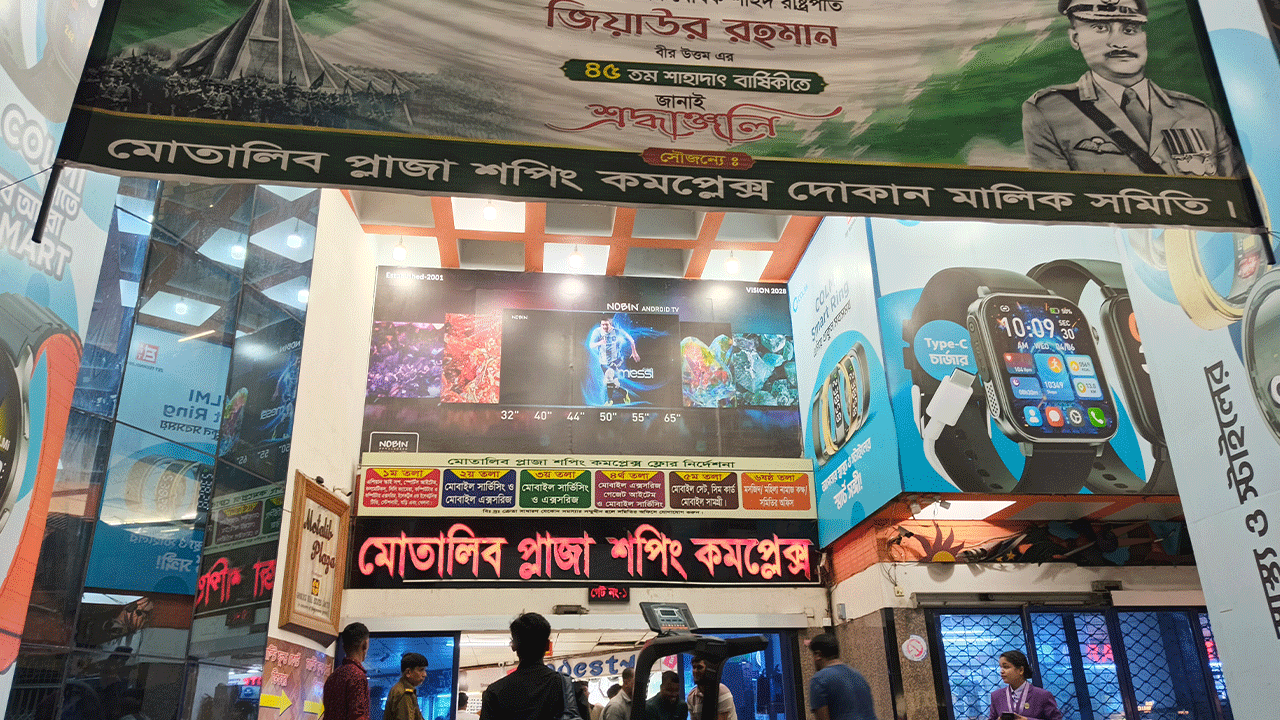
A dispute between two rival factions of the Bangladesh Nationalist Party (BNP) over the leadership of the Motalib Plaza Shop Owners' Association has escalated, leaving more than 700 shop owners at one of the country's largest mobile phone markets in a state of uncertainty.

The conflict centers on the association's presidency, with Khandaker Akter Hamid Pabon, son of late BNP Secretary General Khandaker Delwar Hossain, and former Jubo Dal leader Mahbubur Rahman Bacchu claiming legitimacy.
The dispute intensified after Pabon's supporters allegedly entered the market with outsiders, occupied the association's office, and seized control. The matter has since reached both the police and the High Court. Business owners say the ongoing conflict has disrupted normal commercial activities and created an atmosphere of fear.
Speaking to Asia Post on condition of anonymity, two traders said the political infighting has negatively affected daily sales. They warned that if the situation continues, the market's business environment could suffer long-term damage.
How the Dispute Began
Following the July uprising that led to the ouster of then Prime Minister Sheikh Hasina, senior leaders of the previous market committee reportedly went into hiding. On November 11 of that year, traders formed a new committee through a general meeting.
Under the 31-member committee, former senior vice-president Mahbubur Rahman Bacchu assumed the role of president, while former treasurer Shah Alam Bepari became general secretary.
From the outset, however, Khandaker Akter Hamid Pabon and his supporters opposed the committee.
The committee survived after intervention by senior BNP leaders. Its two-year tenure is scheduled to expire in November this year.
After the BNP formed the government following the 13th parliamentary election, a dispute emerged between Bacchu and Shah Alam Bepari over the management of the association's funds, reportedly worth several crore taka. Shah Alam later aligned himself with Pabon.
On May 16, Pabon allegedly led a show of force in the market with a group of outsiders and took control of the association's office. The following day, he announced a new committee with himself as convener and Shah Alam Bepari as member secretary.
High Court Petition
Describing the unilateral formation of the new committee as illegal, Mahbubur Rahman Bacchu filed a writ petition with the High Court on June 9.
On June 11, the High Court directed the existing committee to ensure that no party obstructs the election process for the next executive committee of the Motalib Plaza Shop Owners' Association. The court also issued a rule asking why the defendants' inaction and failure to arrange the election should not be declared illegal.
The Inspector General of Police (IGP), the Commissioner of Dhaka Metropolitan Police (DMP), the Director General of the Department of Labour, and two other respondents were asked to respond to the rule within two weeks. The court further instructed the authorities to resolve the matter within 30 working days.
Bacchu alleged that the court's directives have yet to be implemented.
"The Supreme Court has issued an order, but neither the administration nor the Department of Labour has taken any action to implement it," Bacchu told Asia Post.
He said traders are living in fear and want a free and fair election.
"I want to hand over the association's leadership to genuine traders through an election. But I cannot even enter the association's office. My supporters are being assaulted," he alleged.
According to Bacchu, the association currently has Tk 12 million (Tk 1.2 crore) in cash, which he claims is being spent arbitrarily by those occupying the office. He also alleged that revenue from advertising spaces and rental income is not being properly deposited into the association's accounts and that traders are being pressured to sign new agreements.
Pabon and Shah Alam Reject Bacchu's Presidency
Pabon rejected Bacchu's claim to the presidency.
"There is no president named Mahbubur Rahman Bacchu. The person making this claim has never been president. He is misrepresenting a High Court order and spreading misinformation, which is why a case has been filed against him," Pabon told Asia Post.
Pabon claimed that his group had originally established the market.
"My elder brother was previously the association's president. During the Awami League's 17 years in power, we were unable to enter the market. Now I have legally taken charge of the committee, and traders are satisfied. On the other hand, the person claiming to be president has occupied a basement warehouse and misappropriated money," he said.
Motalib Plaza falls within the Dhaka-8 parliamentary constituency, and local political influence over the association is significant.
Pabon claimed that BNP leader and local Member of Parliament Mirza Abbas was aware of the committee he announced.
Speaking by phone, Pabon said he was currently in Malaysia to visit Mirza Abbas.
"I am in Malaysia at the moment to see Mirza Abbas uncle. My committee's member secretary, Shah Alam, is at the market. You can contact him if you need any information," he said.
Shah Alam Bepari also rejected Bacchu's claim.
"Mahbubur Rahman Bacchu was never president. After August 5, he declared himself president. That committee had no legal validity," Shah Alam told Asia Post.
He further claimed that the committee in which he serves as member secretary was formed directly by Mirza Abbas and that no other committee exists.
Police Attempting Mediation
Advocate Mohammad Siddiq Ullah Mia, counsel for the petitioner in the High Court, said the court had instructed the respondents to submit their replies within two weeks and directed authorities to ensure that no one obstructs the election process.
"However, we have not yet seen any visible progress from the administration. We hope the issue will be resolved soon," he said.
Deputy Commissioner S.K. Zahidul Islam of the DMP's Ramna Division said police have been trying to mediate between the two sides.
"After receiving the court order, we invited both parties for discussions. But when one side attends, the other often does not. Our primary responsibility is to maintain law and order. We will certainly assist in holding a fair election, while continuing our efforts to keep peace between the two sides," he said.
From Dablu to Jubo League and Back to BNP
Motalib Plaza was built in 1999 by Eastern Housing under a joint venture on land owned by businessman Alhaj Abdul Motalib in Hatirpool. The 14-storey complex includes five commercial floors and nine residential floors.
The plaza is widely known as one of Bangladesh's largest mobile phone markets, housing more than 700 shops.
After the BNP came to power in 2001, the first shop owners' committee was formed, headed by Khandaker Abdul Hamid Dablu, son of late BNP Secretary General Khandaker Delwar Hossain.
When the Awami League assumed power in 2009, control of the committee shifted to then Kalabagan Thana Jubo League president Azizul Haque Aziz and Jubo League leader Azad, an associate of former Dhaka South City Corporation Mayor Sayeed Khokon. Following the July uprising, leaders associated with the Awami League and its affiliated organizations reportedly fled.
With their departure, rival BNP factions began competing for control of the shop owners' association, with both sides focusing on the association's substantial financial resources.
In addition to existing funds, the association collects monthly service charges ranging from Tk 1,500 to Tk 5,000 per shop for lighting, generators, cleaning, and other services. It also earns significant revenue from advertising and renting out vacant commercial spaces.
Under the association's rules, these funds are meant to be spent for the welfare of traders and employees. In practice, however, control over the fund has become the main source of conflict, fueling the ongoing instability at the market.