


Forgery across official records: RAJUK transfers Tk120 million plot after 41 years
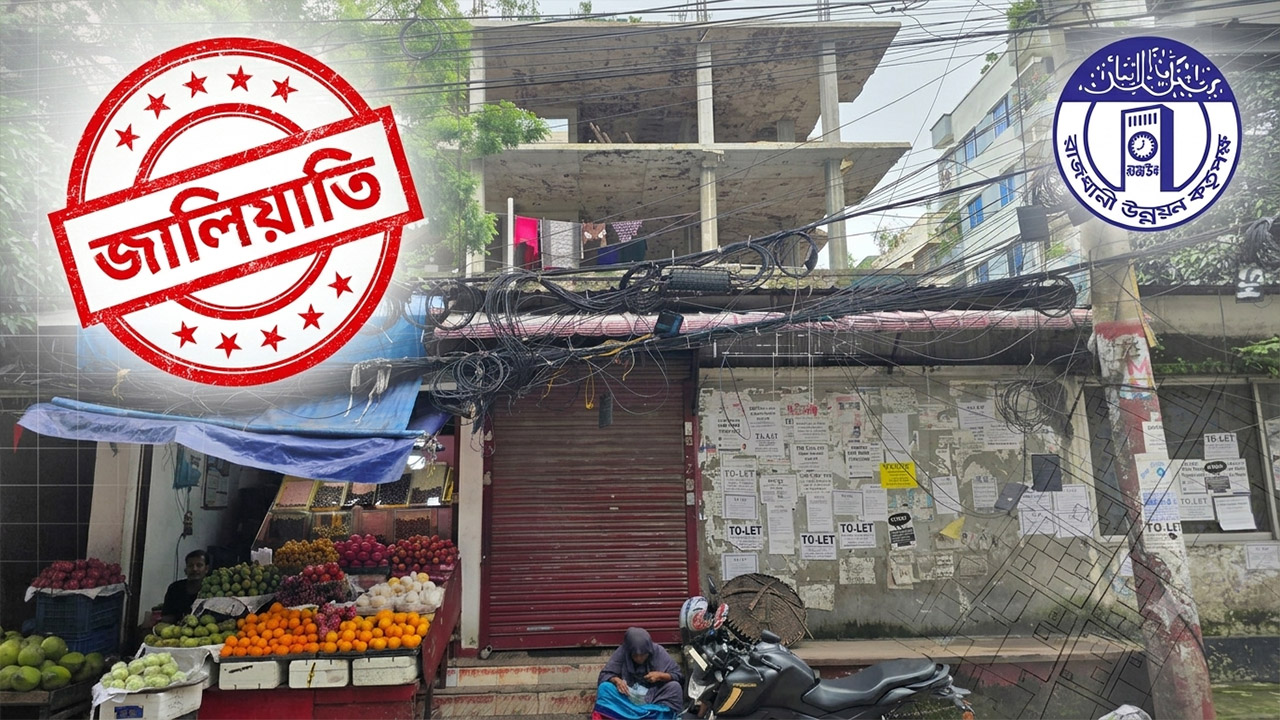
A series of forged documents has surfaced in a decades-old case at the Capital Development Authority (RAJUK), leading to the transfer of a residential plot worth around Tk120 million despite the file having effectively expired more than four decades ago.

The alleged fraud centers on Plot No. 14 on Road No. 2 of the Nikunja-2 Residential Area Project. Despite evidence of document tampering—including altered bank receipts, signatures of deceased individuals, and a fake award certificate—the two-katha, eight-chatak plot was not only mutated but also received final approval for transfer. According to current market estimates, the property is worth between Tk120 million (Tk12 crore) and Tk150 million (Tk15 cr).
The names of RAJUK Chairman Riazul Islam, Member (Estate and Land) Matiar Rahman, and Deputy Director (Estate and Land-2) Md. Asaduzzaman Biswas—son of former minister Abdul Latif Biswas—have emerged in connection with the alleged irregularities.
Asia Post's investigation, prompted by a written complaint recently submitted to the Ministry of Housing and Public Works, found specific evidence suggesting that the three officials, along with an organized syndicate, were involved in the alleged forgery.
Allocation Was Not Cancelled Despite Breach of Conditions
The land was originally acquired by RAJUK from local landowners through the district administration. On February 14, 1985, Plot No. 14 in the Nikunja-2 project was finally allotted to Abdus Sattar under the "affected persons" category.
Under the allotment agreement, Sattar was required to pay the plot price in four installments.
According to RAJUK records, he paid the first interest-free installment of Tk6,667 on March 31, 1985. The second installment of Tk16,444, due by March 31, 1986, was never paid. Likewise, the third installment of Tk14,667, due by March 31, 1987, also remained unpaid.
The fourth installment of Tk12,889 was due on March 31, 1988. However, it was accepted only on May 18, 2022—34 years after the deadline, in clear violation of the rules. Following a series of administrative procedures, RAJUK finally confirmed the allotment in the name of a woman identifying herself as Mumtaz Begum on January 8 this year.
Under RAJUK's Plot Allocation Rules 2024 and previous regulations, an allottee may clear overdue installments with additional interest for a maximum of seven years after receiving the allotment letter. There is no legal provision allowing payment after 34 years.
Because the installments remained unpaid, the allotment should legally have been cancelled long ago and the land should have reverted to government ownership. Instead, according to the investigation, the plot was fraudulently transferred into private ownership under the guise of handing it over to Abdus Sattar's heirs.
When asked how a file dormant for 41 years had suddenly been revived, RAJUK Member (Estate and Land) Sheikh Matiar Rahman admitted to Asia Post that accepting payments after such a long period was not lawful.
"The receipts for the second and third installments showed extensive alterations, making verification impossible," Rahman said. "Since the receipts date back to 1987-88, the bank no longer has the relevant records. We have now become aware of the detailed allegations of forgery and will take action promptly."
Widow's Application Revived the Dormant File
Asia Post found that on December 7, 2017, a woman identifying herself as Abdus Sattar's wife, Mumtaz Begum, applied to the RAJUK chairman seeking a corrected allotment letter.
She claimed that her husband had been seriously ill for many years, preventing timely payment of the remaining installments.
According to her application, she only became aware of the allotment after her husband's death on September 7, 2016. However, records show that around the same period she had already received another plot—Plot No. 31 on Road No. 18 (North), Nikunja-2—under the same category while identifying herself as Abdus Sattar's wife.
After she applied for mutation as the widow and legal heir, the then RAJUK chairman instructed the Estate and Land Division to examine the matter. Yet the file remained inactive for nearly a year.
On February 4, 2018, Mumtaz Begum submitted another application. This time, then Senior Secretary of the Ministry of Public Administration Dr. Md. Mozammel Haque Khan endorsed her request. His visiting card remains attached to the official file.
The then RAJUK chairman marked the matter as "most urgent" and ordered officials to retrieve the three-decade-old file. According to investigators, this marked the beginning of the file's "extraordinary transformation."
Manjurul Haque's Receipts Became Abdus Sattar's
After Mumtaz Begum's application, the file moved through several RAJUK offices. During that process, key information and bank statements inside the file were allegedly altered.
To create the appearance that the overdue installments had been paid, investigators say officials resorted to forged documentation even though the money had never been deposited into the government treasury.
An official note dated March 15, 2019, from RAJUK's Estate and Land-2 subdivision clearly stated that only the first installment had been paid.
However, in another official note dated February 7, 2021—just three years later—the record claimed that the late Abdus Sattar had paid all installments.
Document analysis shows that pages 16 and 20 of the file contain photocopies of two Sonali Bank DIT Branch deposit receipts: Receipt No. 1276 dated May 17, 1987, for Tk16,444 and Receipt No. 168 dated January 2, 1988, for Tk14,667.
The original receipts are missing. Only altered photocopies are attached.
A review of the original bank records obtained by Asia Post revealed that Receipts No. 1276 and 168 were actually issued against Plot No. 3 on Kobi Faruk Sarani in Nikunja-2.
The original allottee of that plot was Manjurul Haque, who had deposited the money for his own property in 1987 and 1988.
According to the investigation, the syndicate photocopied Haque's original bank receipts and carefully altered the allottee's name and plot number, replacing them with those of Abdus Sattar and Plot No. 14.
These forged receipts were then inserted into the file on pages 16 and 20 to falsely establish that all dues had been paid.
The then Director of Estate and Land-1, A.B.M. Ehsanul Mamun, recommended in an official note that the chairman verify the bank's ledger records directly. However, investigators found that the verification was never carried out.
Deputy Director Named as Key Figure
The investigation identifies RAJUK Deputy Director Md. Asaduzzaman Biswas as one of the principal architects of the alleged fraud.
Officials familiar with the file said the plot had legally reverted to government ownership because the installments were never paid. By using forged payment receipts, the land was fraudulently restored as private property, causing substantial financial losses to the government.
Investigators estimate that, apart from the value of the land itself, the government also lost several million taka in accumulated interest and penalties that should have been collected over nearly four decades.
Asia Post repeatedly attempted to contact Asaduzzaman Biswas at his office and by mobile phone but received no response. Questions sent through WhatsApp also went unanswered.
Ershadul Haque, Assistant General Manager and Branch Manager of Sonali Bank PLC's DIT Branch (now RAJUK Bhaban Branch), said:
"The bank never verifies deposit receipts verbally. If any organization wants to verify whether a receipt was deposited or in whose name it was issued, it must submit a formal written request. We also respond only in writing. RAJUK has no opportunity to rely on verbal verification in such matters. During my tenure, I did not provide any verbal confirmation regarding these records."
Signatures of the Dead and a Mountain of Forged Documents
The alleged forgery in this file does not end there. On page 183 of the plot file is an attendance sheet of the heirs dated February 6, 2022, bearing the signature of one heir, Mohammad Alauddin. However, RAJUK's own records show that he had died several years before the attendance was recorded. His death certificate is preserved in the file of Plot No. 12 under the Nikunja-2 Project.
This raises an obvious question: How could a deceased person return from the grave to appear at the RAJUK office and sign the attendance sheet? The question has also been raised by RAJUK officials themselves. In an official note submitted to the chairman, the director stated that Alauddin's photograph had been attached to the file later. Under official procedures, the office seal should be stamped partly on the photograph and partly on the document. However, no seal appears on the photograph.
A written complaint submitted to the ministry alleges that the inheritance certificate attached on pages 30 to 37 of the file and the "award certificate" issued by the Deputy Commissioner's Office on page 9/A are both entirely forged. Officials from the Land and Estate Department also stated in writing that the opinion attributed to the MIS branch in note paragraphs 25-30 had likewise been fabricated through forgery.
Bank statements preserved on pages 111 to 113 of the file, obtained by Asia Post, also reveal irregularities. While the security deposit column mentions Tk10,000 and the first installment column states Tk6,670, the total amount is recorded as only Tk1,000.
Furthermore, paragraph 5 of clause 6 in the power of attorney document preserved on page 165 states that the first installment of Tk30,000 was paid through Islami Bank. However, according to condition No. 4 of the final allotment letter, installment payments were required to be deposited exclusively into the "D Account-20" at Sonali Bank's DIT Branch.
The file contains no explanation as to how installment payments for a government plot were accepted through Islami Bank in 1985, or how the installment amount increased from Tk6,667 to Tk30,000.
Concealing Information About Multiple Plots
In Note Paragraph 7 on page 3 of the disputed plot file, an official remarked that the allottee owned multiple plots in Gulshan, Banani, or Baridhara in addition to the Nikunja plot. Therefore, the official recommended obtaining the ministry's opinion before making any final decision.
Verification of the documents shows that the original applicant, Abdus Sattar, had himself admitted in an application that he had already been allotted a plot in Baridhara and had requested to surrender the rehabilitation plot allocated to him in Joar Sahara. Under RAJUK regulations, the same individual or family cannot retain multiple plots. Despite this, the crucial information was allegedly suppressed in the file.
Questions Over the Identity of Momtaz Begum
After 33 years, a woman named Momtaz Begum suddenly appeared, claiming to be the wife of Abdus Sattar. RAJUK's own records express serious doubts about her identity.
Former RAJUK Director (Estate) ABM Ehsanul Mamun noted that the birth certificate attached on page 117 of the file was clearly forged. Momtaz Begum's date of birth is listed as July 12, 1945. Under the 17-digit birth registration system, the first four digits should reflect the birth year (1945). However, her certificate begins with "2008," bearing the registration number 2008***78.
According to the birth certificate, her permanent address is Gobindapur village in Rupganj Upazila of Narayanganj district. However, the award certificate and affidavit submitted with the file identify her permanent address as Sukundi village in Kaliganj Upazila of Gazipur district. How a person with two different permanent addresses and a forged birth certificate was still granted ownership of a plot worth millions of taka remains an unresolved mystery.
Final Approval Based on Verbal Information
The alleged forgery first came to light when then Director (Estate and Land-1), ABM Ehsanul Mamun, reviewed the file. On December 7, 2025, he documented all the irregularities contained in note paragraphs 151 to 161 and recommended to the chairman that a high-level investigation committee be formed and strict action be taken against those responsible.
The findings created a stir within RAJUK. Within days, Ehsanul Mamun was transferred from the Estate Division to the Administration Division. He was replaced by BCS 25th batch officer Mizanur Rahman. Acting on the chairman's instructions, Member (Estate and Land) Sheikh Matiar Rahman assigned the new director on December 21 to re-examine the validity of the previous director's observations.
Speaking to Asia Post, former Director ABM Ehsanul Mamun said:
"I made my recommendations based on the old records of the plot. Every irregularity I identified is supported by documentary evidence. Afterward, I was transferred from the Estate Division to the Administration Division. However, I do not believe my transfer was because of this matter. Transfers are a normal part of government service."
Meanwhile, at RAJUK's 25th General Board Meeting of 2024, a four-member investigation committee headed by then Deputy Director Tahmina Begum was formed to investigate the alleged forgery. The committee was instructed to submit its report within 15 working days. However, no report has ever been submitted, and the file contains no information regarding its findings. Instead, note paragraphs 136-150 omitted all references to the investigation and proposed retaining the plot allotment.
Tahmina Begum, now an official at the Ministry of Finance, said:
"In such investigation committees, the concerned director serves as the member secretary. It is the director who convenes meetings and presents the documents. None of that happened here."
"After I was transferred in September last year, the committee should have been reconstituted according to the rules. Only after the committee submitted its report should the board have taken a decision. Ignoring the investigation report and deciding on the plot was not in accordance with the rules."
Within just one week of assuming office, on December 29, the new director Mizanur Rahman dismissed all the written objections raised by his predecessor and wrote in an official note: "Everything is in order. Approval may kindly be granted."
Documents and officials familiar with the case said that although Mizanur Rahman claimed in his note that the Deputy Commissioner's award had been verified, the award register recommended for verification by the previous director was never actually examined.
He also ignored questions regarding the forged birth certificate, conflicting addresses, and age discrepancies of Momtaz Begum. The signatures of the relevant parties were never verified.
Without examining whether the bank receipts had been altered or investigating the existence of another plot in Baridhara, he concluded that everything was in order. Despite the allottee's own admission that he possessed another plot, Mizanur Rahman stated there was no plot in Baridhara under the allottee's name.
Defending the disputed installment receipts, he wrote:
"The bank verbally confirmed that the installment payments were valid."
No written bank statement or documentary evidence was produced to explain how installment payments allegedly made 38 or 39 years ago could be confirmed merely through verbal communication.
When the proposal to retain the plot was approved, Deputy Director Asaduzzaman Biswas, Member (Estate and Land) Sheikh Matiar Rahman, and Chairman Riazul Islam raised no objections. Instead, all three simply endorsed and signed note paragraphs 163 and 164 prepared by Mizanur Rahman.
The file also contains no discussion regarding the investigation committee formed by the board.
Finally, on January 8 this year, RAJUK approved the continuation of the allotment and ordered the immediate handover of possession. The authority also approved the mutation of ownership, land registration, and even authorized Momtaz Begum's attorney, Al Amin, to sell the property.
What the Site Revealed
A visit to the plot found that the single-story tin-shed structure on the land was being used as a warehouse by local businessman Shahjahan Mia. Previously, another individual named Lovlu had claimed ownership of the land.
Kabir Mia, who operates a fruit shop in the building, said:
"Previously, a businessman named Shahjahan owned the place. Recently, he introduced another person as the new owner, saying he represented Al Amin. Their manager comes to collect the rent, but I don't know their names or phone numbers."
Asia Post made several attempts to contact former RAJUK Director Mizanur Rahman, who has since been appointed Deputy Secretary at the Insurance Development and Regulatory Authority, asking how he concluded within one week that "everything was in order" despite the previous director's extensive findings of forgery. However, he could not be reached.
Several officials from RAJUK's Estate and Land Department told Asia Post that the allotment of the plot should have been cancelled decades ago and the land should have reverted to government ownership. Instead, they alleged that a current deputy director of RAJUK, using his father's political influence during the Awami League government and leveraging the then Senior Secretary of the Ministry of Public Administration, revived the decades-old file.
They further alleged that the current chairman pressured officials into issuing favorable opinions. When the former director recommended a high-level investigation after identifying forged documents and fake bank receipts, he was transferred. They also claimed that although the government recently appointed a new Member (Estate and Land), the existing official was retained in the position to protect the alleged syndicate.
RAJUK Member (Estate and Land) Sheikh Matiar Rahman said:
"The previous director kept the file pending for a long time. He submitted his note just before being transferred. The new director conducted his own review. His transfer had no connection with this file. He was transferred on the recommendation of the ministry."
RAJUK Chairman Riazul Islam said:
"The matter has come to my attention. At that time, the file had omitted the fact that an investigation committee had already been formed, so the irregularities did not come to light. I have now instructed the relevant department to form a new investigation committee to identify everyone involved in the alleged forgery."
What the Experts Say
Adil Muhammad Khan, President of the Bangladesh Institute of Planners (BIP), said, “Claiming ownership of a plot after 41 years, and then reissuing its allocation despite the failure to pay installments on time as required by the rules, raises serious suspicions about the unusual eagerness of some RAJUK officials."
"Legally, the allocation of this plot should have been cancelled long ago, and it should have become state property. If this asset, now worth significantly more at current market value, is unlawfully returned to a private individual, the state will suffer a substantial financial loss. Moreover, a person with a history of holding multiple plots should not be eligible to receive this plot under any circumstances.”
Dr. Iftekharuzzaman, Executive Director of Transparency International Bangladesh (TIB), said, “RAJUK has become a glaring example of the absence of good governance and entrenched institutional corruption. A powerful syndicate within the organization not only failed to cancel the allocation of a plot despite the non-payment of installments for 41 years, but also manipulated official records by using the signature of a deceased person and forged documents to secure approval for the plot."
"No act of forgery or fraud can confer legal validity on such an allocation. What is even more alarming is that the official who uncovered the forgery and recommended an investigation was transferred as a form of punishment instead of being rewarded. Subsequently, an official favored by the chairman was appointed to the case and gave the file a ‘clean sheet,’ paving the way for final approval."
"This clearly indicates the direct patronage of senior officials. Those responsible, along with the beneficiaries, must be identified and held accountable through exemplary action. The ministry should initiate strict departmental proceedings, refer the matter to the Anti-Corruption Commission (ACC), and ensure that the investigation is protected from interference by any influential quarters.”