


Our state structure turns anyone in power into an autocrat: Hasnat Kaiyum
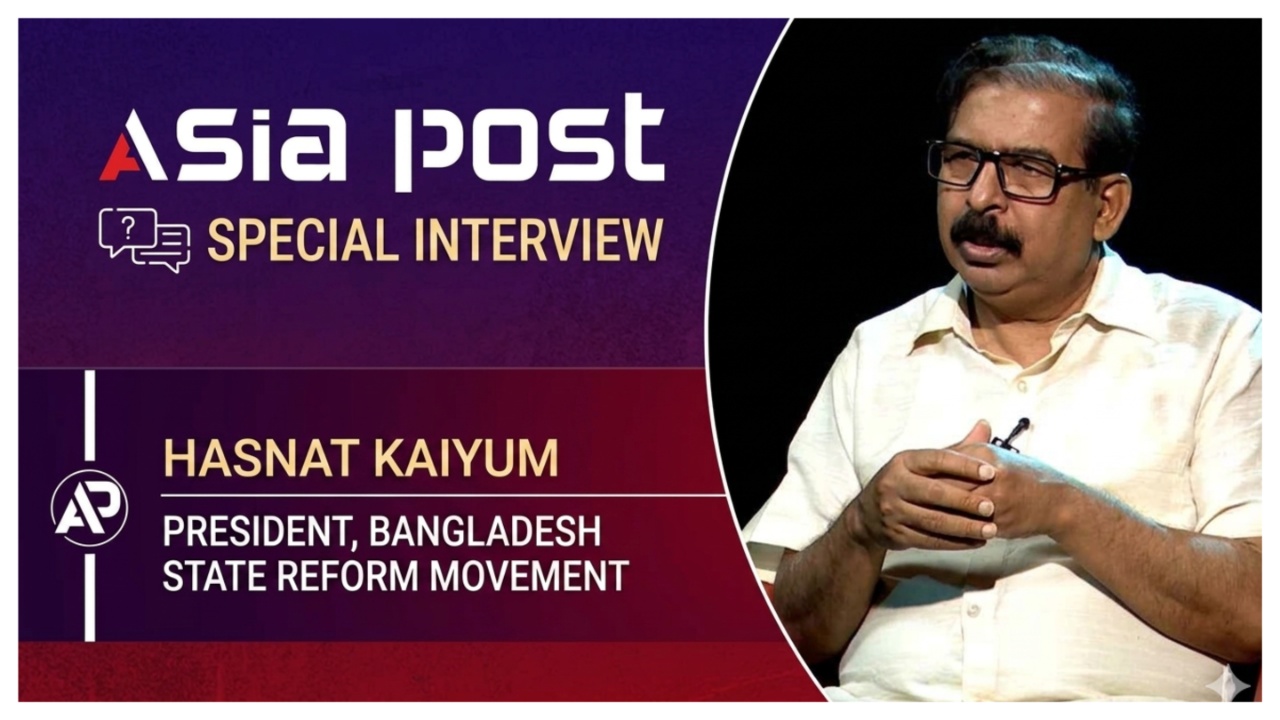
Hasnat Kaiyum is the president of the Bangladesh State Reform Movement. He was a founding vice president of the Bangladesh Students Federation and former organizing secretary of the Bangladesh Writers' Association.

Currently a lawyer at the Supreme Court, he has been imprisoned multiple times while campaigning for the rights of fishermen and farmers in the country's haor wetlands.
He also founded the political alliance Ganatantra Mancha (Democracy Platform). A longtime advocate of constitutional and state reform, he recently appeared as a guest on Alapon, Asia Post's interview series, where he shared his views on state reform, constitutional change, and the future of Bangladesh. The interview was conducted by Rahat Rupantor.
________________________________________
Asia Post: The political landscape has changed dramatically since the July mass uprising. After the events of August 5, discussions have shifted toward state reform and the proposed "July Charter." How are you doing at this stage?
Hasnat Kaiyum: Physically, I'm doing well. But mentally and politically, I find myself caught between hope and uncertainty. I like to think of myself as an optimistic person and always try to remain positive. However, the developments since the uprising have made it increasingly difficult to hold on to that optimism.
________________________________________
Asia Post: From your role as a founding leader of the Students Federation to becoming president of the State Reform Movement, tell us about your political journey.
Hasnat Kaiyum: My entry into politics was largely influenced by my family. My father was involved in leftist politics and was also a freedom fighter. After the Liberation War, he developed political differences with Sheikh Mujibur Rahman and spent many years in underground politics. Naturally, I grew up in a politically active environment and became involved in left-wing politics almost unknowingly.
I began student politics through the Students' Union. But when the organization became increasingly close to the Awami League and Chhatra League, we distanced ourselves for both ideological and family reasons. It wasn't necessarily a conscious decision—it was the political reality of the time.
When my father gradually became inactive in politics, I became more involved. Because of my political activities, he was even jailed as an accused in one of my cases. Yet he never complained that he had to suffer because of me.
Kishoreganj has always been a politically vibrant district. The Naxalite movement had significant influence there. I grew up among people such as Yakub Ali, secretary of the Samyabadi Party, and Anis, a prominent peasant leader.
Even people associated with the Swadeshi movement influenced us.
Throughout history, we believe we stood on the right side. We supported the Liberation War in 1971, opposed the Awami League government after 1975, participated in the anti-Ershad movement, and later joined the quota reform movement, struggles for the landless, and every movement against Sheikh Hasina's government.
We also participated in joint movements with the current governing forces. Although we had opportunities to join larger alliances, we never compromised on our principles.
________________________________________
Asia Post: What has been the greatest challenge in your political career?
Hasnat Kaiyum: The nature of the challenges has changed over time. At one point, I believed the biggest challenge was building a revolutionary organization. But with experience, I realized that the kind of revolution we envisioned might not suit Bangladesh's reality.
The real challenge became identifying what kind of politics Bangladesh actually needs. How do we formulate a politics of reform? It wasn't simply about changing governments or winning elections—it was about presenting a theoretically sound and practically sustainable political agenda.
Today, my biggest challenge is ensuring that an ideological political organization remains consistent with its reform agenda—how internal democracy functions, how members relate to leadership, and how members truly own the organization.
________________________________________
Asia Post: As a lawyer, you frequently write about law, the state, and the constitution. Yet major political parties rarely discuss these fundamental issues and seem more focused on power. Why?
Hasnat Kaiyum: I believe the main reason is our colonial mindset. Consider how political parties emerged in this region. When the Indian National Congress was founded in 1885, its first president was British. The Muslim League also developed with British patronage. Communist parties, meanwhile, were modeled after the Soviet Union or China.
No political tradition emerged that seriously considered what type of state and governance system best suits Bangladesh's geography, society, and national interests. As a result, communists imitate Soviet or Chinese models, Islamist parties look toward the Caliphate or the Faraizi movement, while parties like the Awami League and BNP continue traditions inherited from Congress and the Muslim League.
Even intellectuals have had little opportunity to develop indigenous political thinking. This colonial intellectual legacy remains one of our greatest political misfortunes.
________________________________________
Asia Post: Does that mean politics has become merely a struggle for power?
Hasnat Kaiyum: For many politicians, yes. They view politics primarily as a means of capturing state power, accumulating wealth and influence, and then using those resources to regain power after losing office.
The British came here for business and tax collection, not public welfare. Our politicians inherited much of that political culture. Politics has become one of the country's most profitable businesses.
There's nothing inherently wrong with seeking political power. We also want to govern. But our goal is to ensure that the benefits of independence reach every citizen. The people sacrificed enormously for independence and deserve far more. We seek power to serve people; many others seek it for personal enrichment.
________________________________________
Asia Post: You founded a political party called Ganamukti in the 1990s, which ultimately failed. Later, in 2021, you formed the State Reform Movement. Why did the first effort fail, and why did your new party have to go to court for registration?
Hasnat Kaiyum: Let me answer the second question first. Even after court intervention, we still didn't receive registration.
Since 2013, we have consistently advocated constitutional and state reform. By 2018, we had prepared detailed proposals identifying which constitutional provisions should be changed and what alternatives we envisioned.
To spread these ideas, we formed Ganatantra Mancha. Later, when the BNP initiated joint opposition discussions, we spent seven to eight months helping draft the reform components of its 31-point agenda.
Ironically, after the uprising made reform the country's central political issue, neither the major parties nor the Election Commission acknowledged our contributions. They were reluctant to allow us to become an established political force because we prioritize ideological reform over power politics.
When we launched Ganamukti in 1996, my thinking was still rooted in traditional leftist politics. Its failure helped shape my current political understanding. Today, we advocate a welfare state and sustainable democratic institutions that move beyond the traditional left-right divide.
Initially, we only wanted to spread ideas, assuming someone else would eventually implement them. But when we saw larger parties talking about reform without taking meaningful action, we felt compelled to take responsibility ourselves.
________________________________________
Asia Post: Having spent many years in leftist politics, do you now believe democratic practice is impossible within the traditional left?
Hasnat Kaiyum: Traditional leftist parties have significant limitations. They often pursue distant revolutionary dreams. I sometimes joke that they seek "otherworldly solutions to worldly problems."
Bangladesh today needs reform. Our electoral system, healthcare, education, and judiciary are all dysfunctional. Unless leftist parties adjust their thinking to current realities, they will fail to gain public support.
People today want a humane, knowledge-based, and equitable society. Revolution isn't simply about destroying institutions—it is about making dysfunctional institutions actually work.
________________________________________
Asia Post: How do you evaluate the July mass uprising? Was it merely a student movement, or part of a broader plan?
Hasnat Kaiyum: The July uprising was inevitable. For 17 years, the BNP and other opposition parties had been protesting. The Awami League had transformed governance into a system of repression.
People had lost confidence in established political parties and were waiting for new leadership. When students took to the streets and stood fearlessly before bullets, ordinary citizens joined to protect them.
This uprising was not merely a 36-day movement. It was the culmination of 17 years of accumulated grievances. Its objective was not simply changing the government but transforming the entire system of governance.
Our slogan in Ganatantra Mancha captured that vision: Sheikh Hasina must go, and the system must change so that no future Hasina can emerge.
________________________________________
Asia Post: How successful was the former interim government in carrying out reforms? Are you satisfied?
Hasnat Kaiyum: Frankly, our expectations were not met. Those leading the interim government lacked adequate preparation for state reform. They did not fully understand how sustainable institutional reform should be carried out and often ignored people who had spent over a decade studying these issues.
Our two primary demands were a common minimum reform agenda and a permanent, peaceful mechanism for future political transitions. We proposed creating a Constitutional Reform Council. Although the government eventually accepted the concept, the BNP did not fully support it.
Our goal was to complete fundamental reforms within six months, but delays have left us facing continued uncertainty.
________________________________________
Asia Post: In Bangladesh, every government eventually becomes authoritarian. Why does this keep happening?
Hasnat Kaiyum: The problem lies in our state structure. It is designed in such a way that anyone who occupies the highest office tends to become authoritarian. Once in power, leaders naturally try to preserve their overwhelming authority.
This institutional structure endangered Khaleda Zia in the past, later Sheikh Hasina, and it could eventually create the same situation for the BNP unless the system itself is changed. That is precisely why we emphasize structural reform.
________________________________________
Asia Post: Last year, you often said, "If reform doesn't happen this time, it never will." Why did you consider this the last opportunity?
Hasnat Kaiyum: I partly used that phrase as political rhetoric to motivate the movement. But objectively speaking, this uprising—with its unprecedented sacrifices and mass participation—created the best opportunity in our history for meaningful reform.
If this opportunity is lost, people will become deeply disillusioned and may conclude that no political force deserves their trust.
________________________________________
Asia Post: Who do you hold responsible for the failure to fulfill the aspirations of the July movement?
Hasnat Kaiyum: To varying degrees, everyone shares responsibility.
I would primarily identify three groups: the BNP, Jamaat-e-Islami and the National Citizen Party (NCP), along with sections of the intellectual community. We also acknowledge our own shortcomings.
However, the BNP bears the greatest responsibility because it now holds political power and has received the public mandate. It has the capacity to implement reforms on its own.
Unfortunately, various actors have fueled division and conflict, making reform more difficult. Just as Ziaur Rahman once laid the foundation for multiparty democracy, the BNP now has the opportunity to build a sustainable democratic system for the next fifty years. Why it is failing to seize that opportunity is difficult to understand.
________________________________________
Asia Post: How do you assess the role of students in preserving the spirit of July?
Hasnat Kaiyum: It wasn't only the BNP that failed to uphold the spirit of July. The section of students that moved too close to power also bears responsibility.
Jamaat-e-Islami has often undermined positive developments in pursuit of partisan interests. Meanwhile, many young leaders in the NCP—whom people initially embraced as representatives beyond partisan or religious divisions—lost public credibility by becoming attracted to fame and power.
Instead of becoming leaders for the entire nation, they settled for representing particular groups. They failed to recognize the extraordinary trust that millions had placed in them, and that represents a tremendous loss.
________________________________________
Asia Post: Which constitutional reforms do you consider most urgent?
Hasnat Kaiyum: Our constitution concentrates too much authority in a single individual, whether prime minister or president.
We need meaningful checks and balances. Fundamental rights must become unconditional. The judiciary, legislature, Human Rights Commission, and Election Commission must all be made genuinely independent.
________________________________________
Asia Post: Do you see any possibility of the Awami League returning under current circumstances?
Hasnat Kaiyum: In its current form, I don't see a path back for the Awami League.
Its first step should be to apologize to the nation for its actions. It should express genuine remorse for killings, enforced disappearances, false cases, and financial corruption. Those responsible should cooperate with judicial processes and seek political reconciliation.
Unfortunately, I don't see the party moving in that direction.
________________________________________
Asia Post: Left-wing parties are often accused of acting as proxies for either the Awami League or India. As a former leftist, how do you respond?
Hasnat Kaiyum: There are both cultural and political reasons behind this perception.
The left in Bangladesh is broadly divided into two streams. One effectively serves the Awami League, while the other aligns more closely with the BNP.
For one group, being progressive largely means embracing European or West Bengal-centered cultural perspectives, which naturally align them with the Awami League. On the other hand, some pro-China leftists become so focused on opposing India that they sometimes compromise with religious fundamentalists.
Because these groups generally lack an immediate strategy for gaining power themselves, their activities often end up serving the political interests of larger parties.
________________________________________
Asia Post: Finally, what is your vision for Bangladesh's future?
Hasnat Kaiyum: I hope Bangladesh will move toward genuine democracy. I hope young people free themselves from political illusions and remain committed to their ideals.
We missed historic opportunities in 1971 and again in 1990. I hope we do not lose the opportunity created in 2024.
My father left me with his political aspirations. I do not want to pass that same burden to the next generation. I simply hope to see Bangladesh move in the right direction.