
The Guardian Report: What behind Bangladeshis’ love for Brazil and Argentina
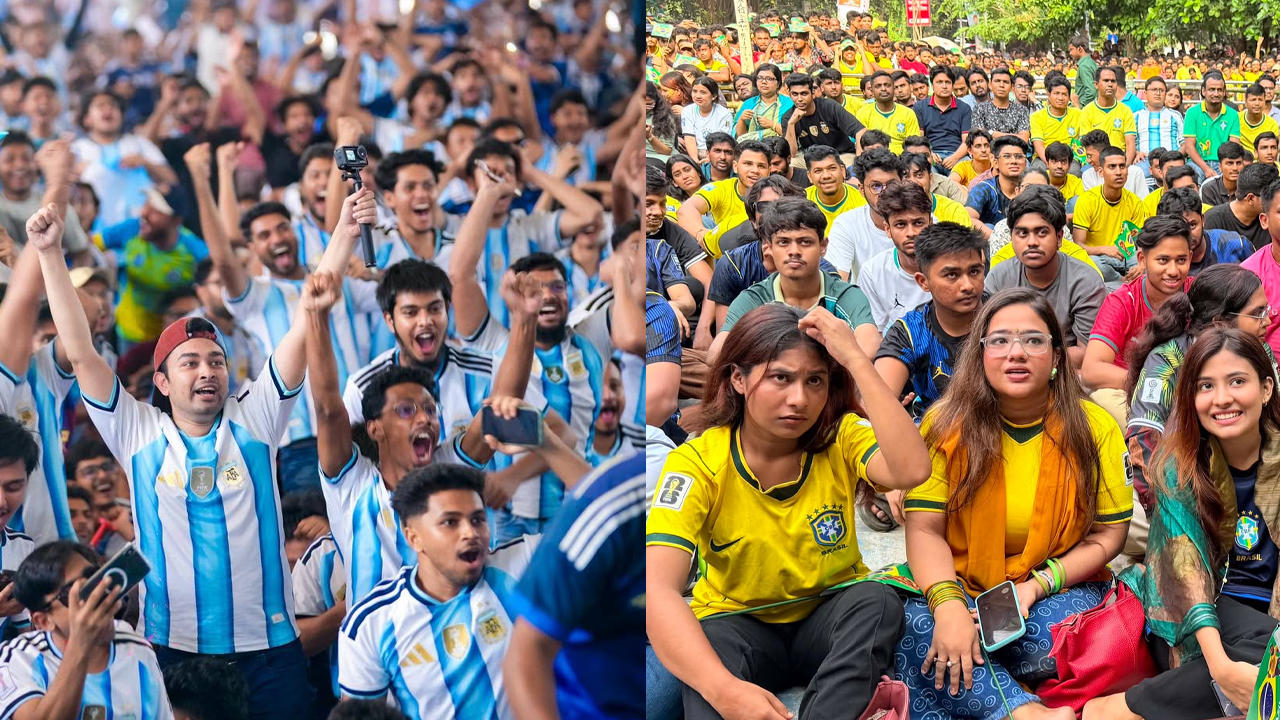
Bangladesh is home to more than 170 million people. For decades, both Bangladeshis and members of the Bangladeshi diaspora have passionately supported the Latin American football giants, Brazil and Argentina.
In the early 2000s, Shahidul Partha was growing up in Kulkandi, Bangladesh. During every FIFA World Cup, villagers would gather in the courtyard of his family home to watch the matches. More than 80 people would crowd into the yard.
They watched the games on a 14-inch black-and-white battery-powered television—the only TV in the area. As they followed the action, they sipped milk tea and ate biscuits. Whenever Brazil or Argentina scored, the crowd erupted in celebration.
"It was such a beautiful time," recalls Partha, now 35. "It felt as though they were playing alongside the footballers on the field."
Today, Partha lives in Hatfield, Pennsylvania, where he works as a software engineer while also serving as a township commissioner in local government.
"When a goal was scored, everyone would scream at the top of their lungs," he says. "People became incredibly excited. They would shout, 'Go, go, take the ball forward!' Sometimes they even gave instructions like, 'Go this way!' or 'Pass over there!'"
Although he now lives thousands of miles away from Bangladesh, Partha continues to support Brazil. For him, cheering for the team evokes cherished memories of home.
Bangladesh's national football team has never qualified for the FIFA World Cup. Yet that has never diminished the country's deep love for the sport. Across Bangladesh and among its diaspora, millions have long embraced Argentina and Brazil as their teams.
The scale of this passion is evident in online audiences. During Argentina's opening match against Algeria on June 16, nearly 20 percent of the traffic to The Guardian's live match blog came from Bangladesh.
Recently, in the district of Brahmanbaria, a devoted Brazilian supporter painted his house green and yellow in the colors of Brazil's national flag and decorated its exterior walls with murals of famous footballers.
Bangladeshi Americans say that supporting South American teams helps them stay connected to their culture and heritage while also reminding them of Bangladesh's own struggle for independence.
Following independence from West Pakistan in 1971, Bangladesh gradually developed its broadcasting infrastructure.
Support for Brazil in Bangladesh largely began during the 1970s, when Pelé was at the height of his international fame. As citizens of a newly independent nation, many Bangladeshis identified with Brazil—a former colony itself. Pelé's inspiring journey from poverty to global superstardom deeply resonated with them.
Mehedi Farhana vividly remembers studying Pelé's early struggles and extraordinary success in her third-grade history textbook during the 1980s.
"We were a Third World country," says Farhana, now 48 and an associate pharmacist living in Hatfield, Pennsylvania. "We had very limited resources, but we wanted to prove to the world that we could succeed."
Farhana and her family have been lifelong supporters of Brazil.
She still remembers waking up in the middle of the night as a child to watch Brazil's World Cup matches.
"They were like us," she says. "They were poor. They didn't have many resources. But they proved that they could achieve greatness."
During the 1980s, color television became increasingly popular across Bangladesh. For many Bangladeshis, the 1986 FIFA World Cup was the first tournament they watched on television.
Bangladesh Television (BTV), the state broadcaster, aired the tournament live. Millions of viewers were captivated by the performances of Brazil and Argentina. That experience sparked a lasting cultural phenomenon that has been passed down through generations.
In the quarterfinals of the 1986 World Cup, Argentina defeated England—a country that had ruled present-day Bangladesh for nearly two centuries under British colonial rule. During that match, Diego Maradona scored his infamous "Hand of God" goal, a moment that continues to fascinate Bangladeshi football fans to this day.
Anik Chowdhury, a 40-year-old Bangladeshi American from Long Island, New York, believes these football legends represented something much larger.
"These superstars emerged and defeated countries that had once been colonial powers," he says. "In a sport like football, that naturally captured people's hearts."
Chowdhury also observes a generational divide among Bangladeshi supporters.
"My family supports Argentina," he explains. "But my mother's older relatives support Brazil."
"The older generation always talks about Pelé because the 1970s belonged to him. Then came Maradona in the 1980s. And now our generation has Lionel Messi. That's how the passion has been passed from one generation to another."
The 1986 World Cup took place during a politically turbulent period in Bangladesh. Military rule dominated much of the 1970s and 1980s.
Veteran journalist and writer Ibrahim Chowdhury, who has worked in journalism for over four decades, was then a political activist. Having recently graduated from university, he was involved with an international labor movement organization and was often forced into hiding from the authorities.
Despite the political repression, football offered a rare escape.
"We were fighting against military dictatorship," says Chowdhury. "Football was our only source of entertainment. The police were searching for us, yet we still gathered together to watch the World Cup."
While they watched the matches, one of their friends stood outside keeping watch for police.
"For the entire duration of the World Cup," he recalls, "all political activism seemed to pause. It remains one of the most memorable periods of my life."
Now 65, Ibrahim lives in North Brunswick, New Jersey. This summer, he is finally fulfilling a lifelong dream by serving as a volunteer at the FIFA World Cup, where he will welcome spectators and help direct them around the venues.
"I always wanted to cover the World Cup as a journalist," he says. "That opportunity never came. So when the tournament was awarded to the United States, Canada, and Mexico, I applied both for media accreditation and as a volunteer. I was accepted as a volunteer."
After New York City, Paterson, New Jersey, is home to one of the largest Bangladeshi-American communities in the United States. Most members of a local Bangladeshi-American football club there support Argentina.
Since its establishment in 2018, the Bangladeshi-American Sports League has attracted hundreds of young players between the ages of 14 and 35.
"For Bangladeshis, this is literally an emotion," says the league's General Secretary, Mansur Latif. "People don't think of Brazil or Argentina as foreign teams. If you speak with them, you'll feel as though they are talking about 'our' team—even though none of us has ever been to those countries."
The 34-year-old engineer proudly describes himself as a devoted Argentina supporter. He especially loves the team's iconic sky-blue and white jersey and treasures memories of watching matches with his brothers during his childhood.
"It's mainly their style of football," he says. "Everything about the way they play is simply beautiful."
Throughout the World Cup, Bangladeshi-American families have organized watch parties in their homes to cheer for Brazil and Argentina.
Although Latif supports Argentina, he passionately cheered for Brazil while attending a friend's watch party during Brazil's victory over Haiti on June 19.
Neither Latif nor Anik Chowdhury was born in time to witness the 1986 World Cup, yet they grew up listening to stories about Maradona's magical performances. Those tales became almost like family folklore, passed from one generation to the next.
Today, Chowdhury is introducing his own young son to the same tradition.
"My son is being pushed into it a little," he jokes while dressing his one-year-old in an Argentina jersey for a photograph.
"This passion gives you a connection to your roots."