
Supreme Leader's week-long funeral: Iran sends strong message to USA
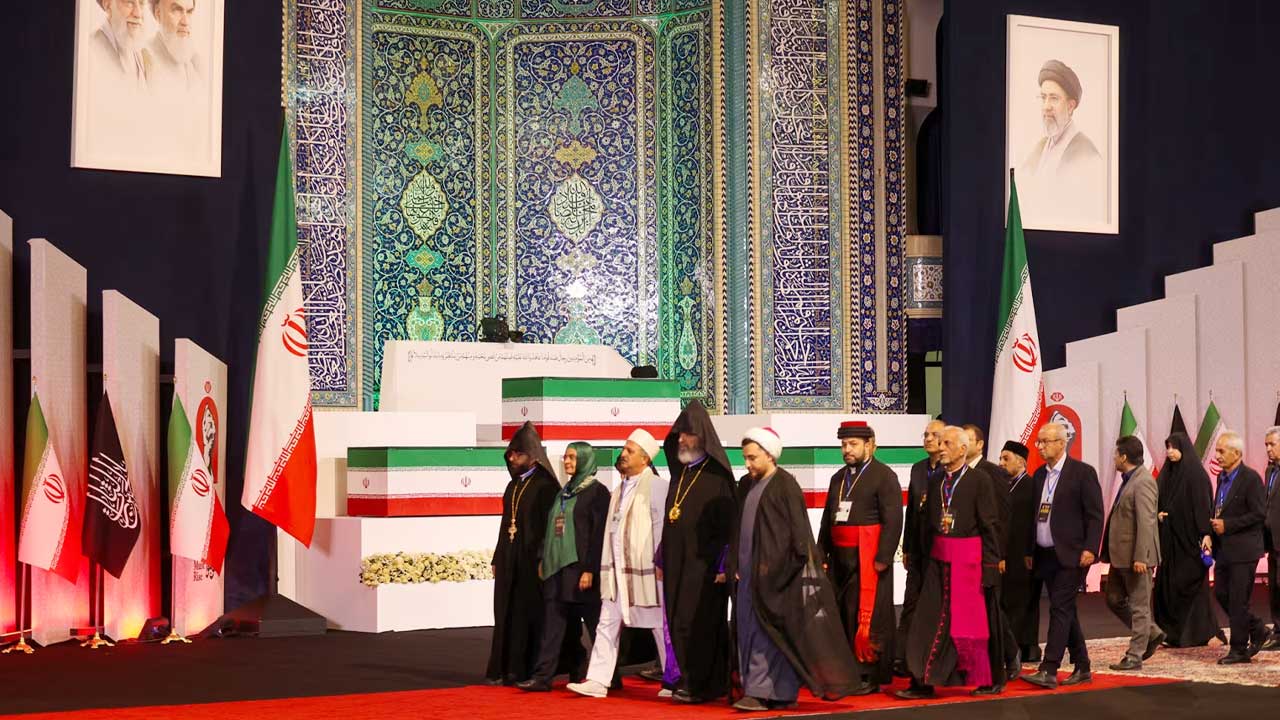
Four months after Iran's then-Supreme Leader, Ayatollah Ali Khamenei, was killed at the outset of the U.S.-Israel war against Iran, the country is commemorating him with a massive week-long funeral ceremony spanning five cities across Iran and Iraq. Authorities expect millions of mourners to attend.
Despite the enormous costs of the war against two of the world's most powerful militaries and decades of severe economic hardship, Tehran has spared no expense in organizing an elaborate funeral infused with religious symbolism. The ceremonies are taking place at the same time as celebrations marking the 250th anniversary of U.S. Independence.
Officials say this is one of the largest funerals in Iranian history. Government employees, teachers, students, labor unions, firefighters, military personnel, volunteers, and religious mourning groups have all been mobilized to manage the crowds and oversee events in cities across Iran and at holy sites in Iraq.
Iraq is also expecting large numbers of pilgrims to pay tribute to Khamenei in Najaf and Karbala.
For more than 10 days, Iranian state media have devoted extensive coverage to the event. Tribute songs and documentaries celebrating Khamenei's life have overshadowed reports of negotiations with the United States that had previously dominated headlines.
The massive ceremony is intended to send a message to the world and to the Islamic Republic's adversaries that the regime has not only survived its struggle for existence but will immortalize its slain leader as a symbol of resilience.
In a message published by state media on Thursday (July 2), Parliament Speaker Mohammad Bagher Ghalibaf, who has led Iran's negotiations with the United States, wrote:
"We must awaken and raise our nation's voice to the world so that everyone knows the honorable and noble people of Iran do not remain silent in the face of oppression... and they will not abandon the blood of their Imam (Ali Khamenei)."
He described the funeral as an epic event that would demonstrate the greatness of the Iranian nation's spirit to the world.
The ceremony may also mark the first public appearance of Iran's new Supreme Leader, Mojtaba Khamenei, who has remained out of public view since the deaths of his father and other family members.
A Ceremony Rich in Symbolism
The dates chosen for the funeral carry significant symbolic meaning.
On the 250th anniversary of U.S. Independence, Ayatollah Ali Khamenei's body will lie in state. One of the major funeral processions also coincides with the annual commemoration of the death of a revered figure in Shiite Islam.
The entire ceremony is being held during the Islamic month of Muharram, a period deeply associated in Shiite Islam with mourning, martyrdom, and betrayal—particularly the remembrance of Imam Hussein's martyrdom in the seventh century. Khamenei regarded himself as an heir to that Shiite tradition.
Known for his uncompromising stance toward the West and deep distrust of the United States, Khamenei served as Iran's Supreme Leader for 37 years. He was killed on February 28 during the opening day of the U.S.-Israel war.
His funeral has been transformed into what authorities describe as a "victory procession" through three Iranian cities and two holy cities in Iraq, intended to convey to supporters that even in death, he remains undefeated.
For supporters, Khamenei's death has elevated him to an even greater symbolic status after decades of confrontation with the United States and Israel.
During his rule, he presided over some of the largest anti-government protests in Iran's history and oversaw harsh crackdowns on demonstrators who called for his death. Despite intense domestic and international criticism, he consolidated the regime's hardline base.
Sina Toossi, Senior Non-Resident Fellow at the Center for International Policy, told CNN:
"This assassination has made Ali Khamenei symbolically far more powerful in death than he was in life. He is now being presented as a martyred religious figure, much like the revered Shiite saints, whose worldview has been vindicated through his death."
Fifty Million Loaves of Bread
Iran has only two previous experiences organizing funerals of this scale: the funeral of Islamic Republic founder Ayatollah Ruhollah Khomeini in 1989 and that of Quds Force commander Qassem Soleimani in 2020. Both processions descended into chaos, with fatalities caused by stampedes.
At the very site where Khamenei's body will lie in state for two days, Khomeini's coffin had to be evacuated by helicopter after grieving crowds tore apart its burial shroud.
Protecting the body, managing millions of mourners, hosting foreign dignitaries, and organizing major events across five cities in two countries represent an enormous logistical undertaking. For a nation emerging from internal unrest and war with the United States, the operation requires unprecedented security measures.
The first public viewing begins at 6:00 a.m. local time on Saturday (July 4), when Khamenei's body will be placed on a raised platform inside Tehran's vast Imam Khomeini Mosalla mosque complex.
To help cool crowds under the intense July heat, firefighters have installed more than 6,000 overhead water sprinklers throughout the complex.
During the official farewell ceremonies, both Tehran's international and domestic airports will be closed. Public holidays have been declared in cities along the funeral route.
Tehran, a city of nearly 17 million people, will implement what officials describe as the largest traffic management operation in its history. Private vehicles will be prohibited near the procession, while more than 700 parking areas have been opened to accommodate arriving mourners.
According to Iranian media, the Basij paramilitary volunteer force has prepared 50 million loaves of bread to feed attendees. Sixteen mobile bakeries have been established in the capital.
The Iranian Red Crescent says Tehran and other major cities are fully prepared for the influx. Authorities have deployed 2,500 ambulances, 21 helicopters, 100 drones, and thousands of emergency personnel. More than two dozen hospitals, 500,000 liters of intravenous fluids, and 20,000 classrooms have also been made available.
The government has launched a nationwide campaign encouraging residents to host visitors arriving in Tehran, Mashhad, and Qom. Mosques, sports halls, parks, and cultural centers throughout the capital have also been prepared to accommodate millions of mourners.
A Display of Strength to the World
On the third day of ceremonies (April 6, as stated in the original report), a major funeral procession is scheduled to travel across Tehran from east to west.
Khamenei's body will then be taken to the holy city of Qom for additional ceremonies before being flown to the Shiite holy cities of Najaf and Karbala in Iraq. Finally, he will be buried at the Imam Reza Shrine in his birthplace, Mashhad.
Iran views taking the former Supreme Leader's body into Iraq as a symbol of the Islamic Republic's revolutionary influence beyond its borders, reinforcing decades of regional projection.
Sina Toossi said:
"His religious followers extend across Shiite communities in Iraq, Pakistan, Bahrain and elsewhere. That's why the planned processions in Najaf and Karbala are so significant. They reinforce the idea that this is not merely an Iranian state funeral, but an international event."
Iranian officials have issued highly ambitious attendance estimates, claiming between 40 million and 150 million mourners could participate, potentially making it one of the largest funerals in modern history. They also say that 14,000 journalists, including 900 foreign correspondents, will cover the event.
State media have spent the past week publishing lists of expected foreign guests. However, only a handful of world leaders are expected to attend, including Georgian President Mikheil Kavelashvili, Pakistani Prime Minister Shehbaz Sharif, and Russian Security Council Deputy Chairman Dmitry Medvedev.
Iranian authorities say eight heads of state and 12 parliamentary speakers are expected to attend. No Western officials have been invited.
Iran's vice president described the funeral procession as one of the most significant events of the century. The interior minister said the goal is to organize the largest farewell ceremony in the country's history.
Ali Akbar Pourjamshidian, head of the organizing committee and a commander in the Islamic Revolutionary Guard Corps (IRGC), said the funeral is intended to demonstrate the Islamic Republic's "strength" to the international community.
Source: CNN